Here is the most expensive sentence in B2B marketing: "How many leads did that post get us?"
Measuring social like a Google ad is the costliest thinking error we see B2B teams make. Search and paid ads capture demand that already exists. Social creates demand that does not exist yet. Judge a brand-building post by last-click leads and you will kill the exact work that fills your pipeline six months from now.
That reframe is what this guide is built on. Most LinkedIn advice chases the small slice of buyers ready to buy today. We do the opposite first: win the 95% who are not in-market yet, so you are the obvious choice when they are, then convert the 5% efficiently. This is a full-funnel playbook for linkedin for b2b marketing in 2026, and it goes deeper than a checklist. Every number below carries a named, dated source, and every section gives you something to act on, not just a definition.
Why LinkedIn is the B2B platform in 2026
Why does LinkedIn keep outperforming other social media channels for B2B? Because professional context is the default: people arrive in a buying mindset, their job title and company are right there, and decision makers are concentrated in a way other networks cannot match. Around four in five LinkedIn members drive business decisions, and roughly 80% of B2B leads from social originate on LinkedIn (Linkedist, 2026).
But the platform advantage is not the strategy. Here are the five truths of B2B social we operate by, and why so many linkedin marketing efforts stall:
- Social is not a direct conversion driver in B2B. It rarely closes the deal on the day of the post.
- So you start at awareness, not the sale. Be known and trusted before the buying window opens.
- Time alone brings nothing. Only strategic content works: an expert sharing useful knowledge, consistently.
- Not being visible has a daily cost. Every day you are silent, a buyer follows your competitor instead.
- Measure the right metrics. Grade the work by its actual job, not by likes.
One anti-pattern quietly wastes more B2B budgets than anything else: the public company diary. Trade-show photos, partnership announcements, the office dog, the "we're hiring" carousel. It feels like posting, but it builds almost no demand. A company diary tells people you exist; strategic content tells them why you are worth remembering.
The strategy: the 95-5 rule
So if social does not close deals, what is it for? Here is the single most useful idea in modern B2B, and the model your whole strategy should run on.
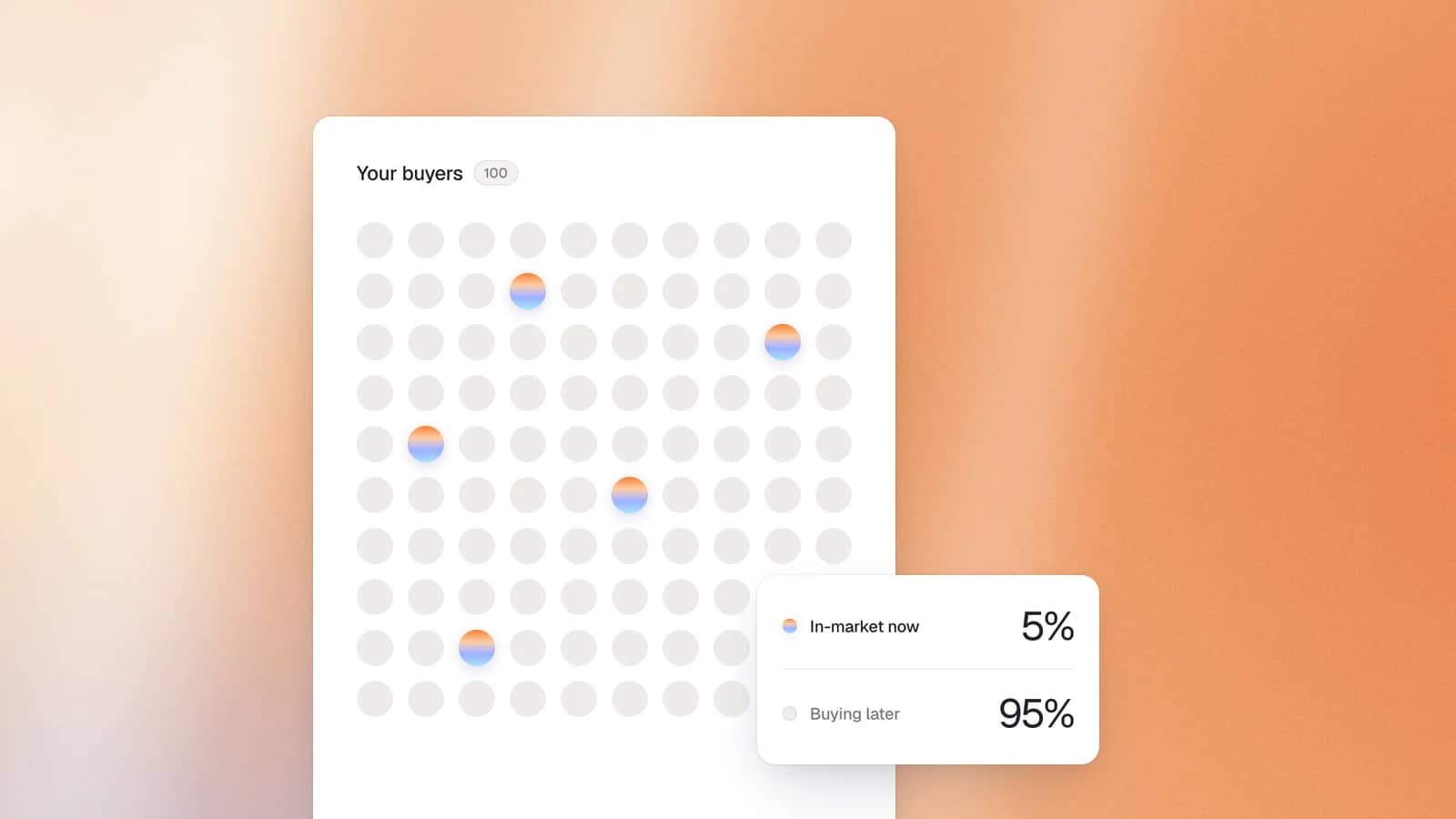
The 95-5 rule comes from Professor John Dawes of the Ehrenberg-Bass Institute, in research popularized by the LinkedIn B2B Institute (Marketing Week, 2021). The finding: at any given moment, only around 5% of B2B buyers are actively in-market. The other 95% are future buyers who will not purchase for months, or years. Content and ads mostly reach people who will not buy soon, and that is not waste. It is the point: the work builds and refreshes memory links, so your brand is the one that comes to mind when a buyer finally goes in-market.
That reframes everything:
- The 95% are served by brand content: expert-led, useful, consistent. You are buying mental availability.
- The 5% are served by activation: linkedin ads, retargeting, and lead-gen offers aimed at people ready to act now.
The honest counterpoint: 5% is a heuristic, not a law. Intent-data advocates argue that in many categories more than 5% are showing buying signals at once. The exact number matters less than the behavior it corrects: pouring your entire marketing budget into the sliver ready today, and ignoring the audience who decides your shortlist tomorrow.
How to split budget and effort between brand and demand capture
This is the section people click for a number, so here is one, with the reasoning.
Think in two buckets: brand (the 95%) and activation (the 5%). A sensible default is to weight brand more heavily, then adjust by sales-cycle length. The longer the gap between first touch and purchase, the larger the share of your audience sitting in the 95% at any moment, so mental availability compounds and deserves more weight:
- Short, transactional cycle (under ~3 months): roughly 50/50 brand to activation. Buyers move fast, so capture earns a bigger slice.
- Medium cycle (3 to 9 months): roughly 60/40 toward brand.
- Long, considered, or ABM cycle (9 to 18+ months): roughly 70/30 toward brand, sometimes more.
A worked example. Take a B2B SaaS company with a nine-month average sales cycle and a $10,000 per month LinkedIn paid budget (organic content is the foundation under all of this and mostly costs team time, not media). Because the cycle is long, weight about 70% to the 95%:
- ~$7,000 to brand and upper funnel: roughly $4,000 into Thought Leader Ads amplifying the team's best-performing organic posts, and roughly $3,000 into video reach (BrandLink or Connected TV if you sell to enterprise).
- ~$3,000 to demand capture: Lead Gen Forms on a genuine offer, plus retargeting of engaged viewers and site visitors.
The $3,000 capture spend will show ROI first, within weeks. The $7,000 brand spend shows up later as rising branded search, more inbound, and a falling cost per lead on the capture campaigns over the following two to three quarters. If you cut the brand spend because it did not convert this month, you make the capture spend more expensive next quarter.
3 steps to build your LinkedIn foundation
Before your first ad or post does anything, three things have to be right: who you are talking to, whose profiles do the talking, and what your company page says when a buyer checks you out.
1. Define your ICP and buying committee
Start with an ideal customer profile built on four fields: company size, industry, region, and the specific job titles that influence the purchase. Then map the buying committee, because B2B is almost never one decision maker. Use Sales Navigator to find and save the real people in each role.
Here is one worked example, end to end. Say you sell a mid-market HR analytics platform. Your ICP is SaaS and professional-services firms, 200 to 1,000 employees, in North America and the UK. The buying committee for a typical deal looks like this:
- Economic buyer: VP People or CHRO. Owns the budget and the business case.
- Champion: Director of People Operations. Feels the pain daily and will sell it internally for you.
- Technical evaluator: Head of IT or Security. Signs off on data and privacy.
- Financial gatekeeper: Finance or procurement. Cares about ROI and contract terms.
- End users: HR business partners and people analysts who will live in the product.
Now the point: your content and your targeting have to reach all five, not just the champion who happens to like your posts. That is exactly the gap Buyer Group Targeting closes on the paid side, which we come back to in the ads section.
2. Optimize the profiles the algorithm reads first
Fix your profiles before you worry about posts, because the linkedin algorithm reads the profile first. LinkedIn classifies who you are before it decides whose feed your content belongs in. Post consistently across two or three topic areas and the algorithm builds a clear picture of your expertise, then rewards you with compounding reach. Topic-hop, and you get random reach forever. Consistency here is not a personality trait; it is repetition the algorithm rewards, and it helps AI search understand what you are known for.
Optimize four building blocks on every profile that will post:
- Slogan (headline): what you help people do, in plain language, not just your job title.
- Header (banner): a clear visual statement of your focus.
- Bio (about): your point of view and proof, written like a person.
- Featured: one link only. Send every click to the single place that matters most.
This is also where the highest-leverage decision in your whole linkedin marketing strategy lives: people, not logos. Trust attaches to humans, and the reach math backs it up. Posts from individual profiles pull around 8x more engagement than the same content from a company page (Linkedist, 2026). You cannot hide behind the company page and expect buyers, or the algorithm, to reward it. Your experts have to speak. Hold onto this idea; it is the through-line that connects your organic engine to your paid strategy later.
3. Set up the company page as a credible home base
Experts carry the reach, but the company page is the credibility check a buyer runs before they reply to a DM or fill in a form. Treat it as the home base that makes your people look legitimate, and give it a real setup pass:
- Tagline: one plain sentence on who you help and how, written so a stranger understands it in three seconds. Work your category keyword in naturally.
- About section: lead with the customer's problem and your unique value proposition, not your founding story. State plainly who you serve, then close with a clear next step.
- Visuals: a clean logo and a banner that states your category and value. Skip the stock handshake.
- Custom button: point it at the single action that matters most (visit website or contact us), not a generic homepage.
- Featured or pinned post: pin your strongest proof, a customer result or a standout founder post, so first-time visitors meet your best work immediately.
Post your organizational-perspective content here (customer stories, culture, milestones handled as strategy, not diary), and let your people amplify it from their own profiles.
How to build the B2B organic content engine
"What do I even post?" is the question that ends most B2B content strategies before they start. Here is the engine that kills it for good.
The Google test
Run every idea through one filter: the Google test. If your post could just be Googled, nobody will read it. Definitions and rephrased blog intros are everywhere already. Social content has to carry what cannot be Googled: your opinion, your experience, your expertise. That is also what makes content quotable by humans and by AI assistants, so passing the Google test doubles as your AI-search differentiator. When you feel an idea drifting toward generic, that is the signal to add the specific number, the real story, or the contrarian take that only you have.
The four content perspectives
The reason you never run out of ideas is that every topic can be played from four angles:
- Personal: a relatable story or lesson. Builds connection.
- Educational: teach something useful. Builds authority.
- Organizational: how your team or company approaches it. Builds trust.
- Promotional: what you offer and who it is for. Builds demand.
One topic becomes four posts. Take a finance firm and "rising interest rates":
- Personal: the client who nearly overextended right before rates moved, and what it taught you.
- Educational: how a rate change flows through to a mid-market company's cost of capital.
- Organizational: how your team rebuilt its advisory process this year to help clients hedge earlier.
- Promotional: the rate-risk assessment you now offer, and who it is built for.
Four strong posts from one idea. Do this across a handful of themes and "what do I post" disappears. Keep that promotional angle to about 15 to 20% of everything you publish, with a hard ceiling of 30%. Too little and nobody knows what you sell; too much and you are back to the company diary.
Which formats perform in 2026
Lead with a takeaway, then pick the format that carries it. Here is how the main formats stack up on 2026 data, and when to reach for each.
| Format | 2026 benchmark | When to use it and how |
|---|---|---|
| Single image / sponsored content | ~0.42% CTR, ~$13 CPC | The reliable cold-reach workhorse. Live or die on the first line and the image; always A/B test the hook. |
| Document / carousel | Lowest CPL, ~$38–82 per lead | Best for teaching and saves. Make slide one the hook and the last slide the ask. |
| Video | 0.24% CTR but ~130% higher completion, +18% lead likelihood | Awareness and consideration. Judge it on completion, not clicks. Always add captions. |
| Thought Leader Ads | ~2.68% CTR, ~$2.29 CPC (≈6x single image) | Your top trust and consideration lever. Amplify a real person's best organic post, not a company ad. |
| Text / dynamic ads | ~0.02% CTR, very cheap | Always-on recall and retargeting on a small budget. A supporting act, never the plan. |
| Message / conversation ads | 3%+ interaction (different metric) | Warm audiences and event invites only. Use sparingly; they can feel intrusive. |
Sources: format CTR and CPC medians from ZenABM's 2026 benchmark dataset (161,256 ads across 211 companies); document-ad CPL from Stackmatix, 2026; video completion and lead-likelihood figures are LinkedIn-reported, via SQ Magazine, 2026.
Whatever the format, the hook does the heavy lifting: on a text post the first two lines decide whether anyone expands it, and on a carousel the first slide is the hook while the asset itself is the "second hook" that earns the save.
The cadence and buffer system
Consistency is a system that runs whether or not the week goes sideways, and something always does: sickness, a launch slipping, a customer escalation.
So separate two kinds of content. Proactive content is the planned, strategic work that must ship no matter what. Reactive content (the award, the event, the announcement) is a bonus, never the plan. Work in two-week cadences and keep a permanent buffer of at least two weeks of content ready (four is better). The buffer is the whole system: it protects your posting cadence when real life interrupts, which it will.
AI in the system vs. AI instead of a system
This is the sharpest question in B2B content in 2026, so let's be precise.
Typing "write me a post about X" into a generic AI tool fails the Google test instantly. It produces confident, competent slop, with the your expertise stripped out. AI used to replace a system gives you more content and less reason to read it.
The better model is AI as a speechwriter. A great speechwriter does not invent the politician's beliefs; they take the person's real knowledge, opinions, stories, and voice, and shape them into something sharp. The expert owns the thoughts; the AI does the drafting. In practice that means capturing an expert's raw input first (a two-minute voice note works better than a blank prompt), then letting AI structure it: this is the philosophy purpose-built tools like Scripe are built around, and it is the only way AI amplifies expertise instead of erasing it.
Employee advocacy and founder-led content
Employee advocacy is not asking staff to reshare the company page (the logo problem again). It is helping real people build an authentic voice around shared themes, and founder-led content is the strongest version: the person with the most conviction, speaking plainly. Give your team light structure and the four perspectives, and a content team of one becomes a roster of credible voices.
LinkedIn Ads in 2026
A "2026" guide has to earn its title here, because linkedin ads changed more this year than in the five before it. The connective idea is the same one from your foundation: build brand with expert-led organic for the 95%, then amplify the same expert voices with paid to reach the 5%. People, not logos, all the way through.
Accelerate vs. Classic
Accelerate is LinkedIn's AI-driven campaign mode that automates targeting, creative, bidding, and placements. When it launched, LinkedIn reported that Accelerate drove 52% lower cost per action and 15% faster setup versus Classic campaigns. LinkedIn has since also cited an "up to 42%" figure in later materials, so treat the exact percentage as directional and vendor-reported, not gospel.
Accelerate needs a pool of conversion data to learn from, so give it several weeks and enough budget to gather conversions before you judge it. Use Accelerate for speed and scale, keeping Classic for precise retargeting and sequenced, funnel-aware campaigns.
Thought Leader Ads
This is the standout format, and it is the paid proof of "people not logos." Thought Leader Ads amplify a real person's post (a founder, an expert) instead of a company ad, so they carry a human face and read like a native post in the feed.
New video surfaces: brandLink, first impression ads, connected TV
LinkedIn is going video-first, and three placements are worth knowing:
- BrandLink: pre-roll in-stream video that runs ahead of premium publisher and creator content. LinkedIn reports around 130% higher completion rates and 23% higher view rates than standard video.
- First Impression Ads: a full-screen vertical video, the first ad a user sees that day, with one brand per country per day. Built for broadcast-style reach at key moments.
- Connected TV: launched in 2024 and expanding through 2026 via partners like Roku, Samsung, and Amazon DSP (AdExchanger, 2024), extending professional targeting to the living-room screen. Awareness, not a lead engine.
Buyer group targeting
Remember the five-person committee from your ICP work? Buyer Group Targeting is the paid answer to it. Instead of chasing one contact, it auto-builds the full buying committee around a target account, which is exactly what account based marketing has always needed. B2B is bought by groups, so pay to reach the group, not just the champion.
The importance of community management
Targeted community management beats volume. Pick five or six fixed accounts whose audience is exactly your target audience (including competitors' posts, where your future buyers already read), and leave around 10 thoughtful comments a week. Then move the warm conversations to DMs to build relationships. Half an hour a week, not a full-time habit.
Do: Comment where your buyers already gather, with a real point of view that adds something.
Don't: Automate comments, ever. It is transparent, annoying, and damages the trust you are building.
Turn it into a lead-generation engine
Everything above becomes a machine when you connect it. The arc is: ICP and buying committee, then conversion-ready profiles, then funnel-mapped content, then ads and forms, then warm outreach, then pipeline measurement. Each stage feeds the next; skip the brand work and your ads pay a stranger tax. Because lead gen is where most guides go vague, here is the how for the three steps that actually capture and convert.
1. Set up Lead Gen Forms properly
In Campaign Manager, choose the Lead Generation objective and attach a native Lead Gen Form. Keep it to three or four fields (name, work email, company, role) because every extra field costs you completions. Write an offer headline that states the value in plain terms, add a one-line privacy note, and wire the form straight into your CRM.
2. Gate an offer worth an email
The offer decides everything. Gate something that earns the address: a benchmark report, an ROI calculator, a template, or a teardown of a real example. "Book a demo" is a 5% offer aimed at the 95%, so it converts poorly as a lead magnet.
3. Run a warm outreach sequence, not a spam cannon
When a lead downloads the asset, start a human sequence: Day 0, send the asset plus one useful insight, no pitch. Day 2, a personalized connection request from the rep that references the download. Day 5, a genuine comment or reaction on the prospect's own recent post, so your name shows up in their world. Day 7, a short DM offering something specific and low-commitment (a relevant example, a quick teardown), not a demo push. Move to a call only when there is a real signal.
For the extended version of this system, see our companion guide to LinkedIn for B2B lead generation.
Amplify B2B sales with LinkedIn
Content and ads warm the market; sales closes it. The bridge between them is a deliberate motion, not hoping a lead raises a hand.
Prospect with Sales Navigator. Build lead lists straight from your ICP filters (title, seniority, company size, geography), save your target accounts, and watch the signals that indicate timing: job changes, funding events, and prospects engaging with your posts. A comment on your content is a buying-intent signal hiding in plain sight.
Map the buying committee before you pitch. Reuse the five-role committee from your ICP work. Instead of selling hard to one contact, get lightly on the radar of each role first (a thoughtful comment, a useful DM, an expert post they see), so that when the deal starts, your name is already familiar to the whole group. This is the human mirror of Buyer Group Targeting.
Run the comment-to-DM-to-conversation motion. This is the organic sales engine, and it is simple: engage genuinely on a prospect's content, let them recognize your name over a few touches, then open a DM with context rather than a pitch, offer something specific and useful, and move to a call only on a real signal. It works because the brand did its job first. That is the 95-5 rule paying off at the individual-deal level.
Measurement that proves pipeline, not vanity
One measurement idea matters most: the buyer journey mostly happens where your tracking cannot see it. This is the dark funnel. Prospects read your posts, screenshot them into a Slack channel, discuss you in DMs, and show up to the sales call already sold, with no clickable trail. Trust only last-click attribution and you will conclude LinkedIn does not work, then cut the thing that is working.
Two fixes, used together:
- Self-reported attribution: ask "How did you find us?" on the demo form and in the first sales call. Unglamorous, and the single most accurate signal you have for the dark funnel.
- UTMs and CRM trace-back: tag the links you can, and connect closed deals back to first touch where possible.
For day-to-day key performance indicators, watch what predicts pipeline, not what flatters your ego. Rank your top performing posts by profile views, profile-to-website clicks, and saves, not likes: a save means someone wants to come back, a profile click means someone is checking your credibility. And because 95% of your work is brand-building, results show up late, so give it a quarter before you decide anything.
Conclusion: win the 95% first
The whole guide in one breath: stop measuring social like a Google ad, build brand for the 95% who are not ready yet, let real experts (not logos) do the talking, convert the 5% with sourced, modern paid tactics and a real lead-gen and sales motion, and measure the demand you create instead of the likes you collect. Do that consistently and you become the brand buyers already trust the moment they go in-market.
The hard part was never the strategy. It was the consistency. If you want to make that part effortless, try Scripe free for 7 days: capture a two-minute voice note and turn it into a finished, on-brand LinkedIn post, batch a two-week buffer in one sitting, and see which posts actually pull saves and profile views.

Co-Founder & CEO
Eva Johanna Egg is the co-founder and CEO of Scripe, where she helps individuals turn their genuine expertise into authentic, high-impact content. With nine years of hands-on social media building and academic grounding in engineering she brings a rare combination of practical platform experience and technical rigor to the personal branding space.
LinkedIn