What Is employee advocacy?
Employee advocacy is when your company's employees promote the organization through their own social media accounts, sharing company content, industry insights, and their own perspective with their personal networks. It positions employees as brand ambassadors and thought leaders rather than leaving all the work to faceless brand channels.
It is worth separating from two neighbors. It is broader than social selling (which is sales teams using social media to build pipeline) and more structured than the occasional viral post from one enthusiastic colleague. A successful employee advocacy program is a repeatable system: the company supplies content and guidance, encourages employees to post, and gets your own employees involved in telling the story, while each person shares in their own voice. When that system runs, employee advocacy extends your reach, your credibility, and your pipeline at the same time.
Why employee advocacy works: the benefits
The case for employee advocacy is not vibes. It is math, and it holds up across trust, reach, and revenue. Here are the benefits of employee advocacy that matter most to a B2B leader.
- It is trusted in a way brand channels are not. Trust in institutions keeps falling while trust in individuals holds. A message from a real person clears a bar a logo cannot.
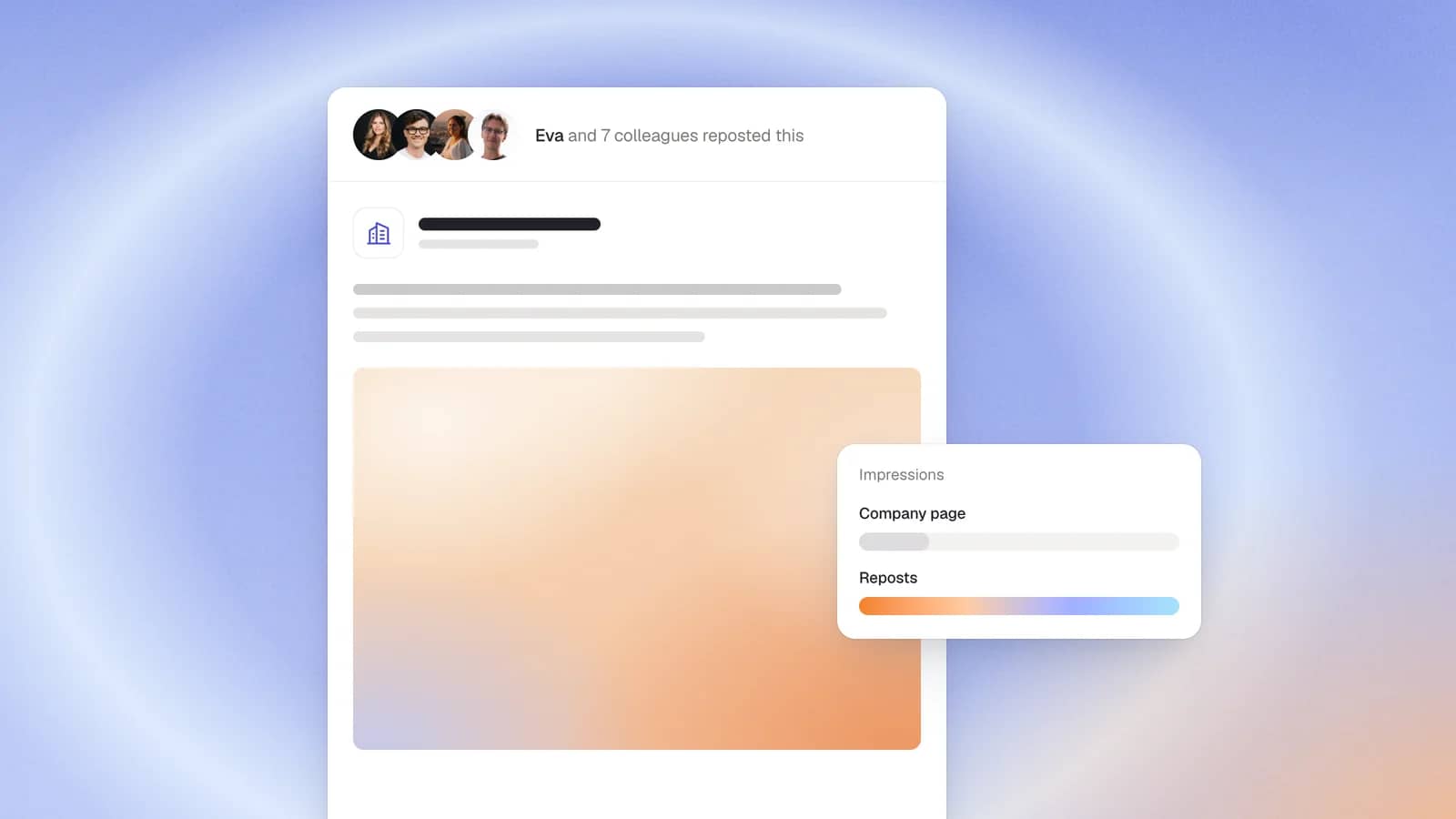
- It multiplies reach and brand visibility that ads cannot buy. You do not even need the whole company: when just 3% of employees share, overall engagement climbs about 30%. This is content distribution that puts you in front of a target audience your company page structurally cannot reach, and it compounds into real brand recognition over time.
- It generates leads and pipeline, not just awareness. On the sales side, reps who sell socially generate more opportunities, and companies with formal social selling programs generate more opportunities than those without.
- It builds your employer brand and helps talent acquisition. When your team shares what it is like to work at your company (culture, employee stories, achievements, professional development, sustainability initiatives), that reaches job seekers no recruiting ad reaches, strengthening your employer brand, your talent pipeline, and the company's overall social media presence at once.
- It is measurable in dollars. Because you can calculate the estimated earned media value (the paid-media cost of the reach you got for free), advocacy translates cleanly into a number a CFO respects.
How to build an employee advocacy program in 6 steps
Most programs fail for the same reason: they are launched as a mandate ("everyone post this") instead of built as a system employees want to be part of. The goal is to encourage employees, not command them. Here is the sequence that turns good intentions into an effective employee advocacy program.
1. Get leadership buy-in and define business outcomes
Before anything else, secure executive support and decide what the program is for: increasing brand awareness, generating leads, hiring, or all three. Tie it to specific business outcomes and a baseline, because a formal employee advocacy program with an owner and a goal survives; a side project does not.
2. Start small, with your most engaged employees
Do not try to activate the entire organization on day one. Begin with a small group of engaged employees who already enjoy being on social media, prove the model, and let it spread. A handful of active advocates who post consistently beats a hundred names on a spreadsheet who never share.
3. Give them content worth sharing, and let them personalize it
Make it effortless to find good material: curate company posts, industry news, and thought leadership into a simple content board. But do not hand out scripts. Personalized shares dramatically outperform copy-paste reposts, so supply the core brand messaging and let each person add their own take in their own voice.
4. Set simple social media guidelines and light training
People stay quiet because they are unsure what is allowed. Publish clear, short social media guidelines (what to share, what to avoid, how to handle questions) and offer social media training so employees feel confident rather than exposed. This is where legal and comms earn their keep by making the safe path the easy path.
5. Make sharing take just a few minutes
Friction kills participation. A good employee advocacy tool lets someone share to their social media accounts in one click and a few minutes, from their phone, without hunting for links. Which brings us to platforms, below.
6. Recognize participation and measure what matters
Celebrate the people who show up: when employees feel valued, they keep going. Light recognition and gamification build an advocacy culture faster than any mandate. Then measure the right things (participation, engagement lift, earned media value, website traffic, and pipeline influence) and feed the results back to the team.
A note on scale: you do not need to ask "how many employees can we force to post?" You need a smaller number of genuinely willing ones. Highly engaged employees are far more likely to advocate.
What should employees actually post?
The fastest way to stall a program is to make it feel like unpaid advertising. The content that works blends four things, and only one of them is about you.
- Educational and industry content: relevant content and industry news that helps their network, published with a point of view. This builds each person's personal brand and positions them as a genuine expert.
- Company content, reframed: product news, data, and success stories, but shared as a human insight ("here is what we learned"), not a press release.
- Culture and people: employee stories, employee achievements, professional development, and the parts of company culture worth showing. This is where employer brand and talent acquisition compound.
- Values in action: corporate social responsibility, sustainability initiatives, and business ethics, shown through real work rather than slogans. Handled honestly, corporate responsibility content builds trust; handled as PR, it backfires.
The ratio matters. Keep hard promotion to a minority of what your advocates post; the rest should be genuinely useful. Employee-generated content that reads like the person actually wrote it will always outperform branded content that reads like the marketing team wrote it.
How to measure employee advocacy success
Vanity metrics will sink your program's credibility with leadership. Measure the chain from activity to business outcomes instead:
- Participation: the share of enrolled employees actively posting (a healthy program runs around 30 to 40%). If participation drops, everything downstream follows.
- Engagement lift: how employee-shared content performs against brand-channel posts in reach and interactions.
- Earned media value: the paid-media cost you avoided for the reach you earned, the cleanest way to express advocacy in money.
- Website traffic: organizations running employee advocacy tag and track it.
- Pipeline influence: meetings, opportunities, and influenced pipeline traced back through UTMs, CRM, and a simple "how did you find us?" on the first call.
Report those upward and the program keeps its budget. Report likes, and it becomes the first thing cut in a tight quarter.
What good looks like
The best employee advocacy examples share two patterns that separate programs that compound from programs that stall. First, they concentrate on the willing: because a small group of active advocates drives most of the results, a company with just 50 committed sharers can become a serious distribution force, no company-wide mandate required. Second, they treat advocacy as a long-term culture, not a campaign. The organizations that win give their people genuine ownership, real recognition, and content worth their name, and the reach compounds every month the habit holds, turning one-off posts into durable brand advocacy.
Conclusion: your people are the program
The one thing that quietly decides whether it works is whether your people have something worth posting each week.
If you want to make that part effortless, try Scripe free for 7 days: let your founders and employees turn a two-minute voice note into a finished, on-brand post in their own voice, so your advocacy program never runs dry.

Co-Founder & CEO
Eva Johanna Egg is the co-founder and CEO of Scripe, where she helps individuals turn their genuine expertise into authentic, high-impact content. With nine years of hands-on social media building and academic grounding in engineering she brings a rare combination of practical platform experience and technical rigor to the personal branding space.
LinkedIn