Content, outreach, or ads: which actually gets you leads?
Organic content, paid ads, and cold outreach are the three ways to get leads on LinkedIn, and they are not interchangeable. They trade off cost, speed, and trust in different ways, so the honest answer is that the best one depends on what you need right now.
| Lane | Cost | Speed to first lead | Trust it builds | The catch |
|---|---|---|---|---|
| Organic content | Low (your time) | Slow | High, compounds | Takes months to build momentum |
| LinkedIn Ads / Lead Gen Forms | Ongoing budget | Fast | Low | Stops the moment you stop paying |
| Cold outreach / social selling | Tool cost | Fast | Low without warmth | Feels spammy, low reply rates |
These are usually pitched as an either/or choice. They are not. Content is the one that makes the other two work better. Warm outreach to someone who has read your posts for three months lands very differently from a cold DM. Ads pointed at an audience that already recognizes your name convert at a fraction of the cost. So even if you eventually run all three, content is the foundation the others stand on.
This is not theory. When OMR's B2B team first tried to grow leads through LinkedIn Ads, they got high costs and, in their words, no new leads. After moving that effort into organic content on their team's personal profiles, they generated roughly ten inbound leads a week and were able to stop running LinkedIn ads altogether.
Why your posts get likes but no leads and how to fix it
Engagement and leads are different outcomes, and content optimized for one rarely delivers the other. A post can get 200 likes from your peers and zero enquiries from actual buyers, because the people clapping are not the people buying.
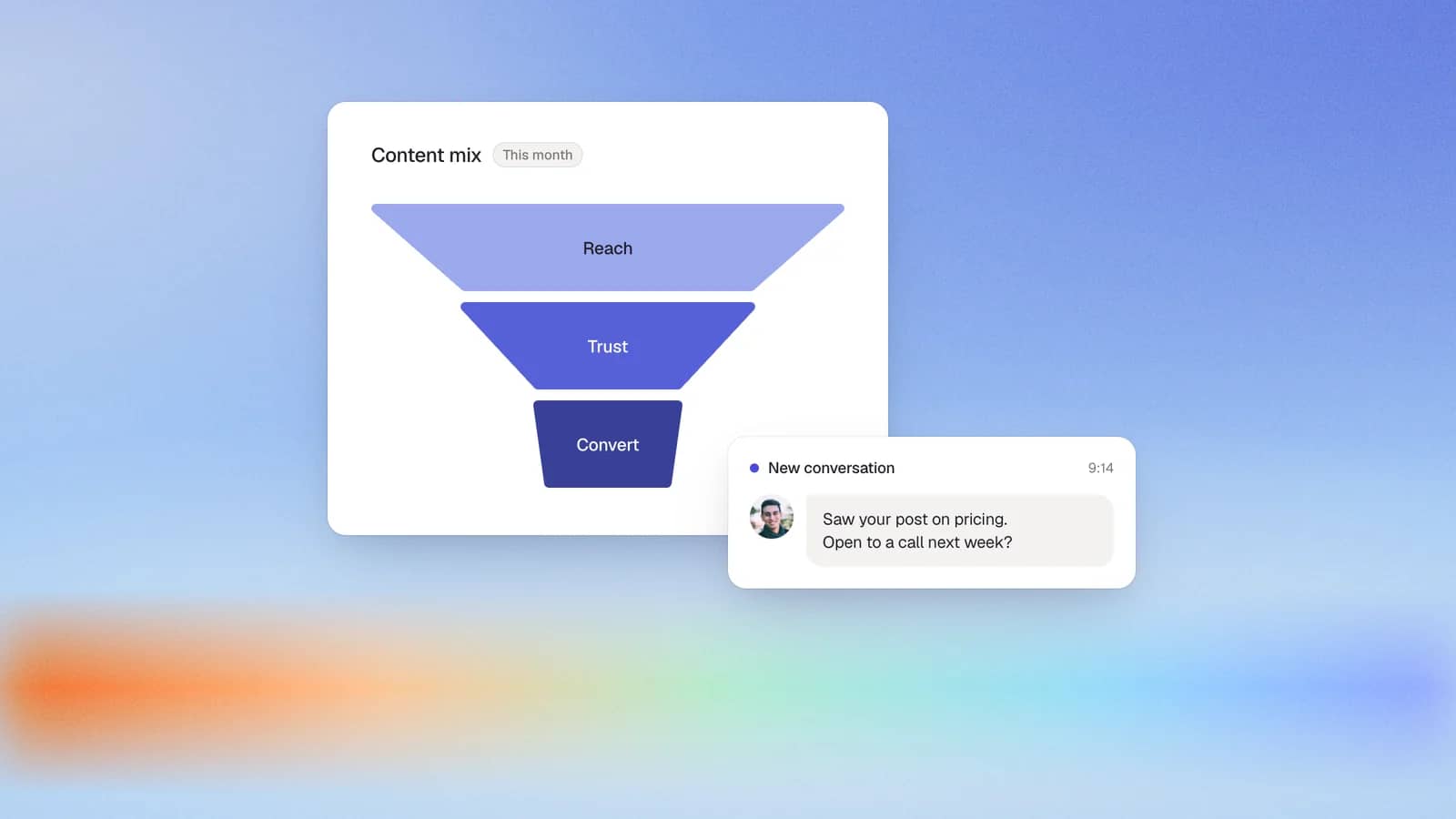
There is a structural reason this feels so discouraging: at any given moment only about 5% of your potential buyers are in-market and ready to act. The other 95% are not looking yet. That is the 95-5 rule, from Professor John Dawes at the Ehrenberg-Bass Institute and popularized by LinkedIn's B2B Institute. It explains the whole game: most of your content should build trust and recognition with the 95%, and a deliberate slice must convert the 5% who are ready now. Most people post entirely for one group or the other, so they either get applause and no leads, or they get ignored for being too salesy.
You can see the payoff of getting this right at ColdIQ, a B2B GTM agency that now attributes roughly 80% of its deals to LinkedIn. Co-founder Alex Vacca describes the effect in one line: "People already trust us before we ever talk to them." That is the 95% doing its job, so that by the time the 5% are ready to buy, the sale is half made. Below are the four fixes, in order. For the underlying strategy foundations, see our LinkedIn content strategy guide.
1. Get specific about who you help and the offer
Vague positioning attracts vague engagement. If your posts could have been written by any of a hundred people in your field, the right buyer scrolls past because nothing signals "this is for me." Make it obvious who you help and which problem you solve, then tie every pillar back to that problem. A consultant who posts "leadership tips" gets likes from other consultants.
The same consultant posting "why your best engineers quit in year two, and what to do in the first 90 days" gets read by the exact VP who is living that problem. Your profile should confirm the same thing in one glance, but that is one sentence of work; the depth is in your posts. More on this in our personal branding guide.
2. Post content that pre-qualifies, not just educates
This is the core move almost nobody makes. Educational content builds reach. Pre-qualifying content makes the right buyer recognize their own situation and self-identify as a fit. The difference shows up in the type of post:
- Problem-aware posts: name the specific pain your buyer feels but has not articulated yet ("your pipeline looks healthy and then three deals slip in the same week, here is what is actually happening").
- Before-and-after stories: a client's starting point, what changed, and the result, so a similar buyer sees their own future.
- Objection-handling posts: take the reason people hesitate to buy and address it in public, before it ever reaches a sales call.
- Decision-criteria posts: teach buyers how to evaluate a solution like yours, which quietly frames you as the standard.
3. CTAs that convert without feeling salesy
Earn the ask by giving value first, then make the next step small and specific. You do not need to end every post with "book a call." Rotate three kinds of call to action: soft ones (a question that invites a comment, or "DM me the word X and I will send it over"), a genuine resource (a guide or breakdown they actually want), and the occasional direct one (book a call, join the waitlist) reserved for posts that have already delivered real value.
The rule is proportion. If nine posts give and the tenth asks, the ask feels earned. If every post asks, people stop reading. This matters more for this audience than most admit: the people best at this work are often the most uncomfortable selling, and a pushy CTA costs them the credibility their content just built.
4. Turn comments and DMs into conversations
Leads are won in the follow-up, which is the step most content advice skips entirely. When someone leaves a thoughtful comment, do not just reply "thanks, great point." Ask them a question back. A comment thread is a public conversation that warms up everyone reading it, and it is the most natural on-ramp to a private one.
When it makes sense, move an engaged commenter to a DM by continuing the specific thing you were discussing, not by pitching. "You mentioned you are dealing with X, I wrote about exactly that last month, want me to send it?" is a conversation. "Hi, I help companies with X, do you have 15 minutes?" is a cold pitch wearing a warm coat. This bridges into warm-signal outreach, which I come back to below.
How to find ideas for lead-gen content
The best source of lead-generating content is not a trends tool or a viral-post swipe file, it is your own sales calls, discovery calls, client questions, objections, and DMs. The reason it works: those conversations are your buyers describing their problems in their own words. Content built from that language attracts more of the same buyers and pre-answers the objections that would otherwise stall a deal. Every objection is a post. Every recurring FAQ is a post. Every "how do you handle X" from a discovery call is a post.
ColdIQ's team found the same thing once they stopped trying to invent ideas from nothing. As Alex Vacca puts it, "You don't need to reinvent the wheel. Just documenting what happens inside the company already gives you a lot of content ideas." Your day-to-day work is the pipeline.
The raw material is the same either way. Record your calls (with consent), keep a running list of recurring questions and objections, and save the DMs where a prospect explains what they are actually worried about. The question is what you do with that pile of transcripts and notes. There are two realistic routes.
You can paste a call transcript or a list of prospect questions into ChatGPT or Claude and ask it to pull out post angles. This works, and for a solo just starting out it is a reasonable place to begin. Prompt it with your positioning and ask for problem-aware and objection-handling angles specifically, not generic "content ideas," or you will get the same bland output everyone else gets.
But keep privacy in mind, a sales call transcript is full of confidential information: your prospect's name, their company, their internal problems, sometimes pricing and contract details. Pasting that into a consumer AI tool means handing a third party data your client did not consent to share, and for agencies handling client accounts that can be a real breach of trust or contract. Strip out names and identifying details before you paste, or do not paste sensitive calls at all.
This is where a purpose-built content system earns its place, and since this is the Scripe blog I will be specific about ours. Scripe's Sources feature lets you upload a call, webinar, podcast, or recording and get ranked post drafts pulled straight from it, scored on things like goal alignment and engagement potential, so you start from the angles most likely to convert rather than a wall of options.
What and how to measure when it comes to LinkedIn lead generation
Measure the signals that sit on the path to a client, not the ones that only feel good. For lead generation the metrics that matter are profile visits coming from your posts, link clicks to your site or booking page, DMs and enquiries started, and eventually calls booked. Ignore raw likes and the occasional viral post that reaches thousands of the wrong people. A post that drove three profile visits from your target buyers did more for your pipeline than one that got 500 likes from strangers.
What LinkedIn's native analytics can and cannot show you
Start with what is free and already in front of you. LinkedIn's native analytics do measure a useful set: impressions and engagement per post, follower growth, and demographic breakdowns of who is viewing your profile and following you (job title, company, industry, location). For pre-qualifying content, those viewer demographics are the signal to watch, because they tell you whether the right kind of person is paying attention.
What native analytics cannot do is show you the last mile. They will not reliably tell you which specific post drove a click to your website, and they blend organic reach in with company-page reach, so you cannot cleanly see how your personal content is performing on its own. That gap is exactly where tools with deeper tracking help. Scripe, for example, separates organic from company-page reach and offers click tracking that shows which profile or post generated a click and where it went.
The easiest attribution method: just ask
You do not need a perfect tracking stack to know if your content is working. The simplest, most reliable attribution is to ask. When someone books a call or sends an enquiry, ask "how did you hear about me" or "what made you reach out," and log the answer. When a prospect opens a DM, notice what they reference, it is almost always a specific post. That self-reported attribution on your discovery calls will tell you more about which content generates real pipeline than any dashboard, because it captures the messy reality (someone read your posts for three months, then a colleague referred you) that no click model can. Track the numbers for direction, but let the words out of your buyers' mouths be the source of truth.
Turn engagement into warm conversations
The people who like, comment on, and repost your content are your warmest leads, because engagement is a buying signal. Someone who has engaged with three of your posts already knows who you are and finds your point of view useful. Starting a conversation there is not cold outreach, it is picking up a thread that already exists. Watch for the real signals: repeat engagers, people who click your links, and profile viewers who show up after you post about a specific problem. Then open a genuine conversation off the back of the exact post they engaged with, referencing what they said.
Scripe as a content system for lead system
Getting one post to convert is not the hard part. The hard part is running content as a system that reliably produces enquiries, week after week, from work you are already doing. That is what Scripe is built for: capture converting content straight from your calls and prospect questions, keep your authentic voice so it sounds like you and not generic AI, and see which posts actually drive clicks and enquiries, with organic reach separated from your company page.
If you want the pride of content that is genuinely yours and a steady stream of the right enquiries
try Scripe for freeFAQs

Co-Founder & CEO
Eva Johanna Egg is the co-founder and CEO of Scripe, where she helps individuals turn their genuine expertise into authentic, high-impact content. With nine years of hands-on social media building and academic grounding in engineering she brings a rare combination of practical platform experience and technical rigor to the personal branding space.
LinkedIn