What is a LinkedIn personal brand?
A LinkedIn personal brand is a clear, consistent reputation for specific expertise and a point of view, held by the right audience. It is not vanity metrics, influencer fame, or a polished corporate persona. That distinction matters more than any tactic in this guide.
Being known by the right people is the goal of personal branding. A post that reaches 50,000 strangers does less for you than one that reaches 500 of your ideal clients and makes three of them remember your name. Most people I talk to do not actually want to "become a creator." They want to be seen by the people who can hire them, partner with them, or refer them, and they want to win business. That is a completely different and far more achievable goal than going viral.
The benefits follow from that: credibility before you ever get on a call, inbound opportunities instead of cold chasing, and trust that shortens every conversation. You do not need fame for any of it. You need to be known, specifically, by the right few thousand people.
Why personal branding feels so hard
Personal branding feels hard because the barrier is emotional, not tactical, and no checklist addresses that. You already half-know what to do. What stops you is the feeling. Let me name the four barriers honestly, because pretending they do not exist is why most advice fails.
- Visibility fear. Posting can feel like walking through a crowded station in your underwear. Putting your thoughts in public, where colleagues and competitors can see them, is genuinely exposing.
- The cringe perception. A lot of LinkedIn content is performative, and you do not want to add to it. The fear of looking like a self-promoting billboard keeps thoughtful people silent.
- Self-doubt. "Who am I to post this?" The imposter feeling that someone more qualified will call you out.
- "I have nothing to say." The belief that everything worth saying has been said, and better.
I will let a real person say it, because he said it better than I can. Philipp Trentmann, CEO of HASE + CO and one of our customers, described his years before posting like this: "I was a constant silent observer on LinkedIn. I even felt guilty because deep down I knew I should post more content." His two blockers were the universal ones: what should I post, and when. And his fear was the cringe one exactly: "My goal was to make a meaningful contribution and not look like a billboard."
These barriers are normal, and more tactics will not fix them. They are fixed by two things: realizing you already have valuable things to say, and posting in a way that genuinely sounds like you. The next two sections are the fix.
You already have the content (you're an expert, not a wiki)
You already have the content, because your job is not to be a wiki. It is to share what you have actually learned. You do not need to be the ultimate authority on your field or teach an encyclopedia. Your experience, your opinions, your mistakes, and the questions your clients actually ask are the content, and they are more valuable than any generic how-to because they are yours and nobody else can post them.
Here is a simple way to find it. Mine your own work for the raw material:
- The questions clients and prospects ask you again and again.
- A decision you made recently and why.
- Something you disagree with that most people in your field believe.
- A mistake you made and what you learned.
- A recent project and one specific thing it taught you.
One real experience becomes several posts: the story, the lesson, the mistake, the contrarian take, the how-to. The problem is never a lack of material. It is that the material slips away before you write it down. This is where capturing ideas as they happen matters, and it is the specific thing Philipp changed. He stopped trying to invent content and started capturing it: he records a voice note after a meeting and it becomes a draft. Your ideas stop slipping away, so you never sit down to a blank page.
How to build a personal brand that sounds like you
A personal brand only works if it sounds like you, so AI-assisted content is fine but generic AI slop is worthless. The test is simple: would you say this out loud, in these words, to a client? If not, do not post it. This is not a small point. In our experience it is both the number-one reason people distrust their own content and a real reason people abandon tools that write for them, because the output is too impersonal to put their name on.
Keeping your voice while using AI comes down to three habits. Feed it your real stories and opinions, not just a topic. Edit for your actual phrasing, the words you really use. And never post anything you would not say yourself. AI should amplify your voice, never replace it.
Start with positioning: who you help and what you're known for
Positioning is deciding who you help, what problem you solve, and the angle only you bring. It is the foundation, and it is usually the real blocker hiding behind "I don't know what to post." If you do not know who you are for, every post feels like shouting into a void.
The formula works as a starting point: I help [audience] achieve [outcome] through [angle or method]. My strong opinion is to go narrow. Being known for one or two specific things beats being a generalist who posts about everything. "I help people with marketing" is forgettable. "I help early-stage SaaS founders turn LinkedIn into a pipeline channel" is someone the right person remembers and refers.
Tie your positioning to a real business goal, not to "building an audience." Audience is a byproduct. Clients and opportunities are the point. One practical warning: do not get stuck here for weeks. Pick the sharpest version you can defend today, start posting, and let real feedback refine it. Positioning is a compass, not a cage. For the deeper strategy framework, see our LinkedIn content strategy guide.
Optimize your profile so it works as a landing page
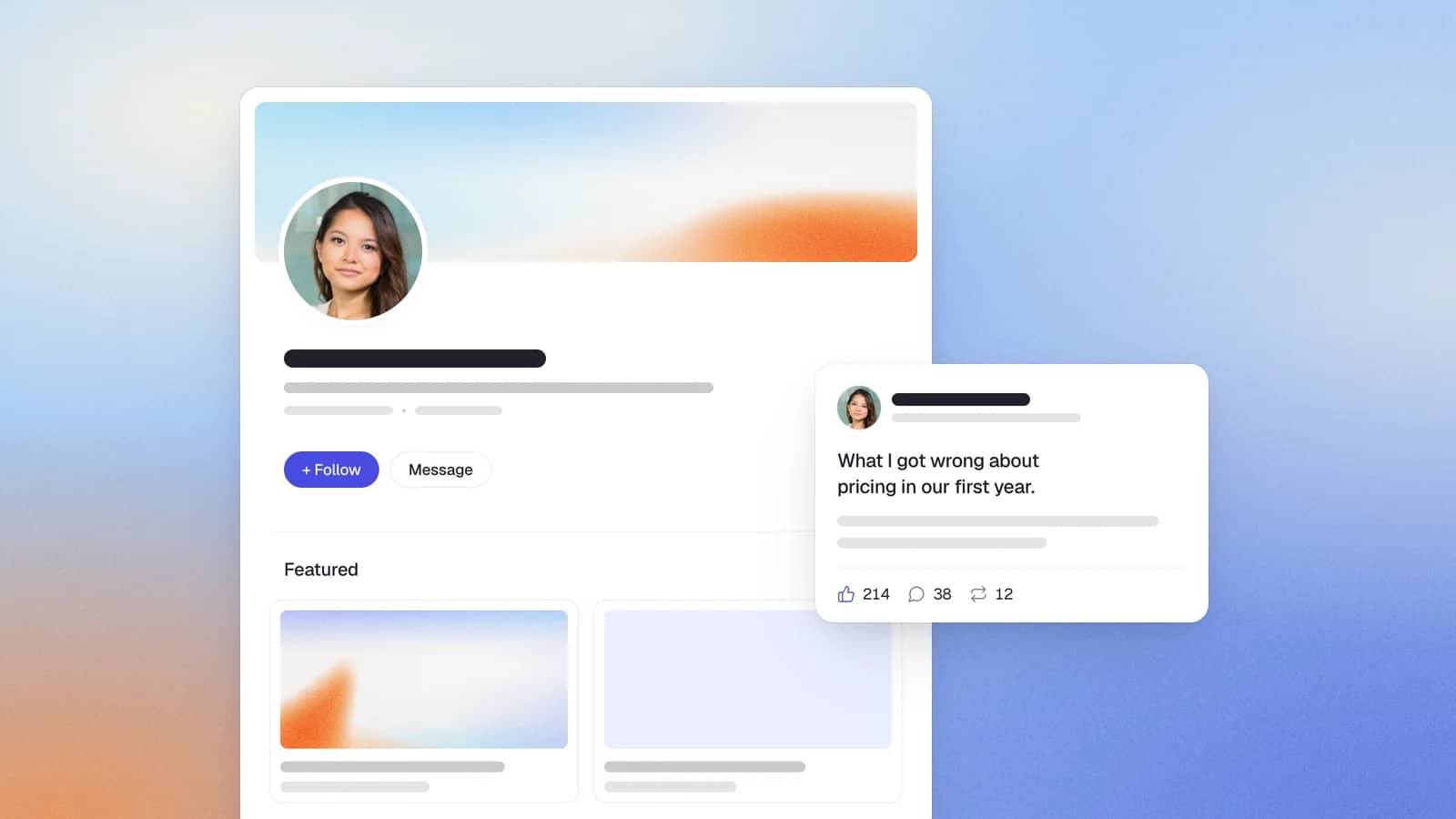
Your profile is the landing page people hit after a post makes them curious, so it has one job: confirm you are worth following. Five things carry it: a clear headshot, a banner that states what you do, a headline framed around who you help, an About section that tells your story and your value, and a Featured section with your best proof.
Practical, tool-agnostic advice is all you need here. Use a friendly, clear photo of your actual face. Put a plain sentence on your banner ("I help X do Y"). Write your headline for your audience, not your job title, so "Helping B2B founders get found on LinkedIn" beats "CEO at Company." Keep the About section in the first person and lead with the reader's problem before your credentials.
My opinion: the profile is table stakes, not the brand. I see people spend three weeks perfecting a banner and zero weeks posting. Get the profile to "good," then move on, because the content is the engine that actually builds your reputation. A perfect profile nobody visits does nothing.
Content pillars for a personal brand
Content pillars are the two or three recurring themes you post about, so your profile feels coherent instead of random. For a personal brand I recommend three: your expertise (what you teach), your point of view and stories (the human layer), and your proof (results and evidence).
My opinion, and the thing most guides get wrong: weight toward the personal pillar. Stories, opinions, and lessons are what separate a personal brand from a faceless content account, and they are exactly what people skip because they feel riskier. The expertise posts earn respect. The personal posts earn the relationship. You need both, but the second is where the brand actually lives.
One honest caveat: do not turn pillars into bureaucracy. Some experienced people find heavy pillar-labelling over-engineered, and they are right when it becomes a spreadsheet you serve instead of a compass that serves you. Keep it light.
What to post: types and examples that perform
The personal-brand content that performs is specific and human, drawn from your real experience rather than generic advice. Here is a bank of post types that work, why each works, and a quick example.
| Post type | Why it works | Example |
|---|---|---|
| Origin story | People trust a person with a story more than a list of credentials | "Six years ago I got fired. Here is what it taught me about hiring." |
| Contrarian / point of view | A clear stance is memorable and sparks conversation | "Most cold outreach fails for a reason nobody admits." |
| Lesson from a mistake | Vulnerability builds trust faster than a win does | "We lost a $40k client. The reason was entirely my fault." |
| Client-question post | Answers a real buyer's real question, which pre-qualifies them | "'How long until LinkedIn actually works?' Here is the honest answer." |
| Behind-the-scenes | Makes an abstract expertise concrete and relatable | "What a normal Tuesday actually looks like running a solo practice." |
| Before-and-after / case | Proof, shown as a story instead of a brag | "How one client went from 200 to 2,000 relevant followers." |
| Framework / how-to | Genuinely useful, and saves and shares well | "The 3-question test I run before taking any new client." |
| "Big change in my industry" | Positions you as someone who sees what is coming | "AI just changed how founders should think about content. Here is how." |
What actually performs is niche-dependent, so treat this as a starting menu, not a ranking. What lands for a fractional CFO is not what lands for a coach. Rather than guess, watch which formats trend in your niche. Scripe surfaces trending formats and real high-performing examples in your specific niche, which is how you keep this list current instead of frozen.
Formats and cadence that work
The formats that work on LinkedIn are text posts, document carousels, native video, and images, each with different strengths. Carousels and video tend to hold attention longer, which the algorithm rewards, while text posts are the fastest to make and still the backbone of most personal brands. Do not feel you have to make carousels to be taken seriously. A sharp text post from a real person beats a mediocre carousel every time.
On cadence, my opinion is firm: consistency at a sustainable pace beats volume, and an over-ambitious schedule is the single biggest reason personal brands die. Start at two to three posts a week. More is not automatically better, especially at the start, because missing your own target kills momentum faster than a slow week ever could. Philipp started at twice a week, and his first viral post (over 77,000 impressions) came within weeks, not because he flooded the feed, but because he showed up consistently in his own voice.
Hot to escape your network bubble
Your network bubble is the plateau where only people who already know you engage with your posts, and you escape it by engaging outwardly and posting things that travel. Here is why it happens: you post, your existing connections react, and the algorithm shows your content to more people like them, which is mostly people you already know. Reach stalls because you are talking to the same room.
Breaking out takes two moves. First, engage outward. Spend real time commenting on the content of your target audience and the adjacent voices they follow, because thoughtful comments put you in front of their networks. Engagement is not optional garnish, it is how new people discover you, and I would argue it matters more than your own posting in the early days. Second, post formats that travel: strong opinions people want to share, frameworks people save, and stories people tag a colleague on.
The system that keeps going without burning out
A personal-brand system that lasts is a light, forgiving rhythm, not a rigid content calendar you will abandon by week four. Almost everyone starts strong and stops within a month, and it is never for lack of ideas. It is because the process depends on willpower, and willpower runs out on a busy week.
As a solo person you have no team to lean on, so the system has to be low-effort by design. Three habits carry it: capture ideas as they happen (a voice note in the moment, not a planning session later), finalize instead of starting from scratch (edit a draft, never face a blank page), and keep a schedule you can actually hold on your worst week. That is the whole system. Scripe supports each part, with weekly post suggestions so something is always queued, capture by voice note, and a finalize-don't-start flow, so momentum does not depend on motivation. This is how Philipp turned posting from a guilty "I should" into a routine that fits his week as a CEO.
DIY, ghostwriter, or a tool?
You have three ways to run a personal brand: do it yourself, hire a ghostwriter or agency, or use a tool. Each trades off cost, control, authenticity, and consistency differently.
| Option | Cost | Authenticity | Consistency | The catch |
|---|---|---|---|---|
| DIY | Free (your time) | Highest | Hardest to sustain | Willpower runs out |
| Ghostwriter / agency | High | Good | While you pay | Expensive, and stops when you stop paying |
| Tool-assisted | Low | High, if it keeps your voice | Good, with a rhythm | You still show up to finalize |
DIY is the most authentic and the hardest to keep going. A ghostwriter removes the work but is expensive, and the real risk is that it stops sounding like you, which for a personal brand is fatal. I have met plenty of people burned by an expensive agency whose posts read like a stranger wrote them, because a stranger did.
Tool-assisted is the middle path: your voice and your control, at a fraction of a ghostwriter's cost. That is where Scripe sits. And to be fair, some people genuinely want fully done-for-you and have the budget, and that is a valid choice. Just go in knowing what you trade for it.
Personal Branding If you're a founder
Founder-led personal branding is different because your personal brand carries the company's story. Lead with the mission and the "why now," not the product. Your profile out-reaches your company page by a wide margin, so as a founder you are the most powerful distribution channel your company has. Investors, hires, and customers all want to back a person they believe in before they trust a logo. We will go deeper in a dedicated founder personal-branding guide.
Start building a brand that sounds like you
You do not need to become an influencer or overcome your personality. You need to be seen, known, and remembered by the right people, in content that is genuinely yours and not AI filler. That is the whole game, and it is very doable.
If you want help doing it without the blank page and without sounding like everyone else, that is exactly what we built Scripe for: capture your ideas before they slip away, keep every post in your own voice, stay consistent without burning out, and see what actually reaches new people.
You can start a free trial and post your first real, sounds-like-you piece this week.
FAQs

Co-Founder & CEO
Eva Johanna Egg is the co-founder and CEO of Scripe, where she helps individuals turn their genuine expertise into authentic, high-impact content. With nine years of hands-on social media building and academic grounding in engineering she brings a rare combination of practical platform experience and technical rigor to the personal branding space.
LinkedIn