What is a LinkedIn content strategy?
A LinkedIn content strategy is the set of decisions that make posting predictable: who you want to reach, what you want to be known for, the two or three themes you post about, and a cadence you can sustain. That part is not complicated, and you probably already know it.
Here is the point almost every guide skips: **strategies fail on execution, not knowledge.** Most people can name the tactics. They stop anyway, usually by week three or four. In the interviews we run at Scripe, the number-one reason is not a missing framework. It is consistency collapse. Enthusiasm drops fast, and the people who most want to post, the founders and the senior experts, have the least time to do it. One customer described his year before Scripe honestly: six posts in twelve months. That is the real failure mode, and no amount of positioning advice fixes it.
So this article is built in the order that actually matters. First how to create the strategy, because that is the fast part. Then what performs, with data, because that is where most guides go quiet. Then how to measure it, then the system that keeps it alive when work gets busy, then how to use AI without sounding like everyone else, and finally how to adapt all of it to your situation.
How to Create a LinkedIn Content Strategy
You create a LinkedIn content strategy in three steps: decide what you want to be known for, choose two or three content pillars, and set a cadence you can sustain. The setup takes an afternoon at most, and you refine it as you learn what performs. Here is how to do each step, with examples.
Step 1: Decide what you want to be known for
Pick a narrow lane. The formula the internet loves still works as a starting point: *I help [audience] achieve [outcome] through [angle or method].* The part people get wrong is the width. Being known for one or two specific things beats being a generalist who posts about everything.
Compare these two:
- Too wide: "I help businesses grow with marketing." (Nobody remembers this. It describes half of LinkedIn.)
- Narrow enough: "I help B2B SaaS founders turn LinkedIn into a pipeline channel without a big content team."
The narrow version tells the reader exactly who you are for and what you talk about, which is what makes them follow and remember you. A quick test: if a stranger cannot summarize your profile in one sentence after reading three of your posts, the lane is still too wide. Write your positioning line down before you write a single post, because every later decision flows from it.
Step 2: Choose 2-3 content pillars
Pillars are the recurring themes you return to so your feed feels coherent instead of random. A simple, universal model uses three: your expertise (what you teach), your point of view (stories and opinions only you can tell), and your proof (results, cases, evidence you can show).
Here is what that looks like for the B2B SaaS founder above:
- Expertise: practical breakdowns, for example "the 4 posts that generated 80% of our demo requests last quarter."
- Point of view: contrarian takes and lessons, for example "why we killed our company page and put the budget into five personal profiles."
- Proof: concrete outcomes, for example a before-and-after of a founder who went from 200 to 2,000 relevant followers in six months.
Some frameworks organize around four pillar types, educational, personal, organizational, and promotional, because the promotional one exists whether you plan it or not. My recommendation for most people: run three core pillars and treat promotion as a controlled minority rather than a fourth habit. How to weight the mix is a data question, and I cover it in the next section.
Step 3: Set a cadence you can actually keep
Two to three posts a week is the sensible default, and more is not automatically better. Choose the cadence you can sustain on your worst week, not your best one.
A realistic starting schedule for someone with a full-time job:
- Tuesday: an expertise post (your most valuable slot, when professional audiences are most active).
- Thursday: a point-of-view or proof post.
- Everything else optional, added only once those two feel effortless.
An over-ambitious cadence is the single most common reason strategies die, because missing your own target feels like failing, and failing kills momentum. Start below what you think you can handle, prove you can hold it for a month, then increase.
What actually performs on LinkedIn (the data most guides skip)
Most strategy guides tell you to post carousels and comment more. Here is what the data actually shows. I can say this with some confidence because Scripe is built on LinkedIn's official Community Management API through developer-partner access, and it learns from a large corpus of LinkedIn posts with real performance data. That access also lets us separate organic reach from company-page reach, which legacy reporting tools cannot do, so the numbers below are not guesses about what feels viral. They are patterns in what performed.
Which formats win right now
There is no single winning format, and that is the honest answer most posts avoid. Text posts, document carousels, native video, polls, and single images all win in different niches. The widely-cited mechanic is real: documents and carousels tend to hold attention longer, and dwell time is something the algorithm rewards. But the ranking shifts by audience. What performs for a fractional CFO is not what performs for a design agency, so the practical move is to watch which formats trend in your specific niche and copy the mechanic, not the topic.
How your pillars should be weighted
You have probably seen the ratio rules: 70-20-10, 5-3-2, 4-1-1 (I explain each in the FAQ). Treat them as useful starting ratios, not laws. A pragmatic mix depends on your goal and on what actually performs for your audience, and you should review it against your own results every month or two, not fix it forever. If your promotional posts quietly outperform your educational ones with your audience, the ratio is telling you something.
What cadence actually correlates with results
Consistency at a sustainable cadence beats bursts. Even without a hard number in front of you, the pattern is clear from thousands of profiles: the person who posts twice a week for a year outperforms the person who posts daily for a month and then disappears. Reach compounds on the back of showing up predictably. So do not optimize for the highest number you can hit this week. Optimize for the number you will still be hitting in six months.
How to tell if your strategy is working
Measure a small set of signals tied to your goal, and ignore the rest. The metrics that matter for most people: qualified profile views and inbound conversations, follower growth inside your target audience (not follower count in the abstract), engagement rate rather than raw likes, and link clicks if driving traffic is a goal. What to ignore: vanity reach and the occasional viral post that pulls in the wrong audience. A post that reaches 50,000 of the wrong people is worse than one that reaches 500 of the right ones.
One trap worth naming: most tools and LinkedIn's native analytics cannot separate organic reach from company-page reach, which distorts whether your personal content is actually working. If your dashboard blends the two, you can think a strategy is succeeding when the company page is doing the heavy lifting. Track the personal-profile numbers on their own.
The operating system for LinkedIn Strategy
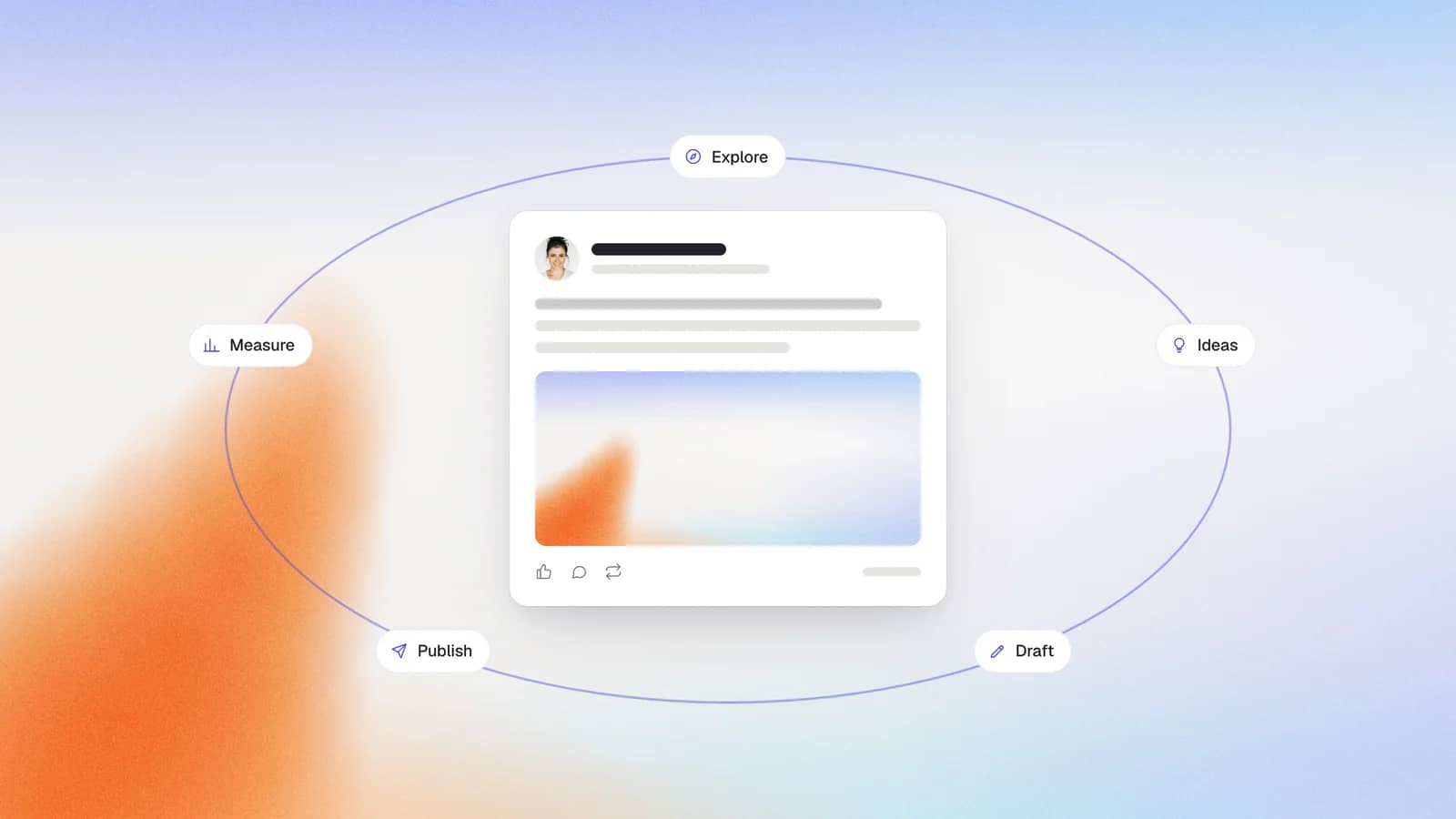
A strategy is only as good as your ability to keep it running when work gets busy, so you need an operating system, not just a plan. This is the part competitors leave out, and it is the difference between a plan and a habit. The system below is a loop with four stages that repeat: capture, draft, finalize, and review. Two of them are quick daily or weekly touches, and one is a short monthly check. None of it depends on feeling motivated, which is the whole point.
Stage 1: Capture ideas as they happen (daily, 30 seconds)
Your best ideas arrive in meetings, on client calls, and mid-conversation, and then they vanish by the time you sit down to post. The fix is a capture habit so raw material is always waiting. Keep one place, a notes app, a voice memo, a single document, and drop every raw idea, client question, or strong opinion into it the moment it happens. Do not polish anything. A capture can be five words: "post about why most onboarding flows fail." The goal is simple: never sit down to a blank page. Most consistency collapses happen at the empty editor, and a full idea list removes that moment entirely.
Stage 2: Draft in a batch (weekly, 60-90 minutes)
Pick one fixed slot a week and turn captures into rough drafts in a batch. Batching works because writing five posts in one session is far easier than writing one post on five separate days: you stay in the same headspace, and one idea sparks the next. You are not aiming for finished posts here, just workable drafts. If you have three good captures and two weak ones, draft the three and leave the rest. A weekly batch of two to three drafts is enough to hold a sustainable cadence with a buffer.
Stage 3: Finalize and schedule ahead (weekly, 30 minutes)
Change the second weekly job from "create from scratch" to "finalize what is already queued." Take the drafts from your batch, tighten the hook, add the personal detail or data point, then schedule them into your calendar for the week ahead. Scheduling ahead is what makes the system survive a genuinely busy week: your posts go out whether or not you open the app on the day. This is also how you plan 90 or 100 days ahead without building a giant calendar in one sitting. You are always working one week in front of live, finishing rather than starting.
Stage 4: Review and feed the winners back (monthly, 20 minutes)
Once a month, look at what actually performed and let it reshape the next month. Which pillar pulled the most qualified engagement? Which format did your audience reward? Which post drove real conversations? Then do more of what worked and quietly retire what did not. This closes the loop: your strategy stops being a fixed document and becomes a living thing that gets sharper every month. Most people skip this stage, which is why their content plateaus. It is the difference between posting for a year and improving for a year.
Using AI without sounding like everyone else
AI should amplify your voice and your real experiences, not replace them. It genuinely helps with ideation, structuring a messy thought, and repurposing one idea into several formats. It hurts the moment it flattens you into the generic LinkedIn voice everyone can now recognize on sight. This is where most people get stuck, and it is the exact problem we built Scripe to solve, so let me be concrete about how.
The authenticity objection is real. "LinkedIn content is cringe, it is all AI anyway" is one of the most common things we hear, and it is fair. Generic AI produces generic posts because it knows nothing about you. Scripe works the opposite way. It learns your voice from your own posts, per profile, so what it writes sounds like you and not like a prompt. On top of that it draws on a knowledge base you feed it, your stories, your case studies, your point of view, so the substance is genuinely yours. The output is content you are proud to put your name on, which is the only kind worth posting.
That per-profile voice is also the honest answer to "why not just use ChatGPT." A general AI model cannot post to LinkedIn, cannot tag profiles, and cannot measure what happened after you hit publish, because those require official access. Scripe is built on LinkedIn's official Community Management API through developer-partner access, with no browser extension and no password sharing, so it connects in seconds and there is no ban risk to your account. It learns continuously from LinkedIn performance data so it knows what is working right now rather than what worked when a model was trained. A general chatbot gives you words. Scripe gives you words in your voice, published on the platform, measured against real reach, and improving every week.
Adapt this to your situation
The foundation is the same for everyone: positioning, pillars, a sustainable cadence, the metrics that matter, and the operating loop. How you apply it shifts with your role.
If you post for yourself (founder, coach, or freelancer)
It is your personal profile and your personal voice, so the whole strategy runs on your own positioning and the stories only you can tell. This is your advantage. A company cannot tell a personal story, and that is exactly what earns trust and inbound enquiries.
Lean into your point-of-view and proof pillars, because your lived experience is the thing no competitor can copy. Your positioning line matters more than for anyone else here, since your name is the brand. Your capture habit is the make-or-break stage: your best material shows up in client work and conversations all week, so catch it then rather than trying to invent it on posting day.
If you run your executives' and team's profiles (in-house marketer)
Your lever is people, not the company page. Personal profiles reach dramatically more than the company page does more in our data, so activating five executives beats polishing the company page every time.
The strategy work is different: you are running the loop on behalf of people who have the least time to spend on it. That means collecting their input without adding meetings to their week, keeping each person's voice distinct so the posts do not read as corporate copy, and reporting the business value back to leadership so the program survives budget season. The two hardest parts are getting busy executives to keep going and proving the results, so build your measurement around organic reach separated from the company page from day one.
If you run clients' profiles (agency)
Same foundation across many accounts, managed in one place, with content that matches each client's distinct voice rather than one house style. Your challenge is scale without sameness: seven clients cannot all sound alike, and the fastest way to lose a client is content that does not sound like them. The operating loop matters most here, because you are sustaining it for other people who will not chase you for it.
Standardize the system, the capture, batch, finalize, and review rhythm, across every account, but keep the voice and knowledge base separate per client. Reliable reporting is the other half of the job, since your renewal depends on showing each client what their profile actually did.
Turn the strategy into a system
A strategy on paper is the easy half. The hard half is running it every week when everything else is on fire, and that is where most people quietly stop. Scripe is built to operationalize exactly the plan in this article: it captures your ideas as they happen, finalizes posts on a rhythm so you are never starting from scratch, keeps your own voice instead of the generic AI one, and shows what actually performs, including the organic-versus-company-page split most tools miss.
If you want the pride of content that is genuinely yours and the visibility and business results that come from showing up consistently, see how Scripe works.
FAQs

Co-Founder & CEO
Eva Johanna Egg is the co-founder and CEO of Scripe, where she helps individuals turn their genuine expertise into authentic, high-impact content. With nine years of hands-on social media building and academic grounding in engineering she brings a rare combination of practical platform experience and technical rigor to the personal branding space.
LinkedIn