


Consulting firms grow through trust — and trust is built where expertise becomes visible. At esentri, that was never in question. The challenge was a different one: how do you make the knowledge of ten specialists consistently visible on LinkedIn when everyone is simultaneously running at 80 to 100 percent capacity on client projects?
Dominik Galler, Director IT Excellence at esentri, had been wrestling with that question since 2022. Several internal attempts to build a LinkedIn presence had fizzled out — until he discovered Scripe in the summer of 2024. What followed was more than a tool rollout: in six months, the team's total reach grew from 20,000 to 300,000 monthly impressions. And beyond the numbers, something harder to measure also emerged — a genuine content culture inside the team.
The starting point: Expertise in abundance, visibility nowhere near enough
esentri is not a company that lacks substance. The team works daily on complex transformation projects, speaks at conferences, and operates in highly regulated, sensitive industries. The expertise is real — and highly relevant to potential clients.
The problem lay elsewhere. In consulting, people decide on contracts. When a company hires a consultancy, they are essentially putting their economic future in someone else's hands. Trust therefore needs to form early — ideally before a first conversation ever takes place.
"When we speak with a client today, it usually takes less than five minutes before they add us on LinkedIn. They just look it up. And when they see someone talking about exactly the topics they themselves are dealing with – that already creates trust.”
– Dominik Galler, Director IT Excellence, esentri
LinkedIn was therefore never a nice-to-have for esentri. It was a strategic tool for building personal brands — and with them, the kind of trust that gets established before the actual sales conversation begins.
The challenge: Staying consistent in a demanding consulting environment
Since 2022, esentri had made several internal attempts to use LinkedIn more systematically. None of them had really gained momentum.
The reason wasn't a lack of motivation – it was a reality that many consulting firms will recognise:
What was there:
✅ Deep expertise across multiple specialist areas
✅ A motivated team with genuine opinions and perspectives
✅ An awareness that personal brands matter strategically
What was missing:
❌ Consistency in content creation
❌ A clear process that fits into a consultant's daily routine
❌ A good answer to the question: "What should I even write about?"
❌ Time in weeks – where client work runs at 80–100% capacity
"We always struggled to stay consistent. In stressful weeks, it was incredibly difficult to find time for posts – and to figure out what to write about in the first place."
≈Dominik Galler
In the summer of 2024, Dominik started researching what kind of support might exist for exactly this problem. He came across Scripe — first through the website, then through a self-funded test account to try the AI features in real use.
"I got a paid private subscription because I wanted to see how good the posts really were. After a month or two, we were convinced – the results were good, the analytics dashboard showed all the bars going up. That's when we said: we want more of Scripe."
– Dominik Galler
The collaboration: Commitment first, tool second
Before the official collaboration with Scripe began, esentri did something that turned out to be decisive: the team was aligned internally on the initiative — before any workshop had taken place.
Dominik's reasoning was straightforward. People who experience LinkedIn content as an obligation stop quickly. People who understand why a strong personal brand is valuable – for their own career as well as for the company – show up differently.
"We explained to the team why this makes sense – for each individual and for us as a company. By the time the kickoff arrived, we had 100% alignment. And everyone was genuinely excited."
– Dominik Galler
The kickoff workshop itself added an extra layer of anticipation: Scripe deliberately withholds platform access until the workshop session – not before. That small detail created real excitement in the team.
The Scripe workshops then built on that internal commitment and provided the methodological foundation: Who is my target audience? What value do I offer them? Which topics do I want to be known for? And what does that actually look like in a LinkedIn post?
"What I particularly appreciated: it wasn't just 'here's the tool, go play with it.' The methodological approach behind it made the tool significantly more useful."
– Dominik Galler
Homework between workshops was practical, directly connected to what had been covered – and it actually got done. Almost no chasing was needed.
First progress: "Document, Don't Teach" – finally working in practice
One of the most important shifts Scripe triggered at esentri is conceptually simple but surprisingly hard to execute in practice: stop waiting for a good content idea to appear – and instead document what is already happening.
Dominik had understood this principle in theory for years. Putting it into practice had kept failing anyway.
"Five years ago I was already thinking about why we couldn't manage to turn what we do every week into content. With Scripe, I just learned: I tell the AI what I did this week. It always has time. And in doing that, I also remind myself of what I actually have to talk about."
– Dominik Galler
Dominik's current workflow: once a week, open the tool, record a short voice note about current projects, thoughts, or learnings – and Scripe distracts from that a set of content pieces that fit his positioning. Even in high-pressure weeks.
"My biggest learning: I used to reach the end of the week and realise I hadn't done anything worth posting about. Now I notice: every day there are five to ten things you could post about. You just have to pick what fits best right now."
– Dominik Galler
The results: 15x reach, conference invitations, and new trust signals
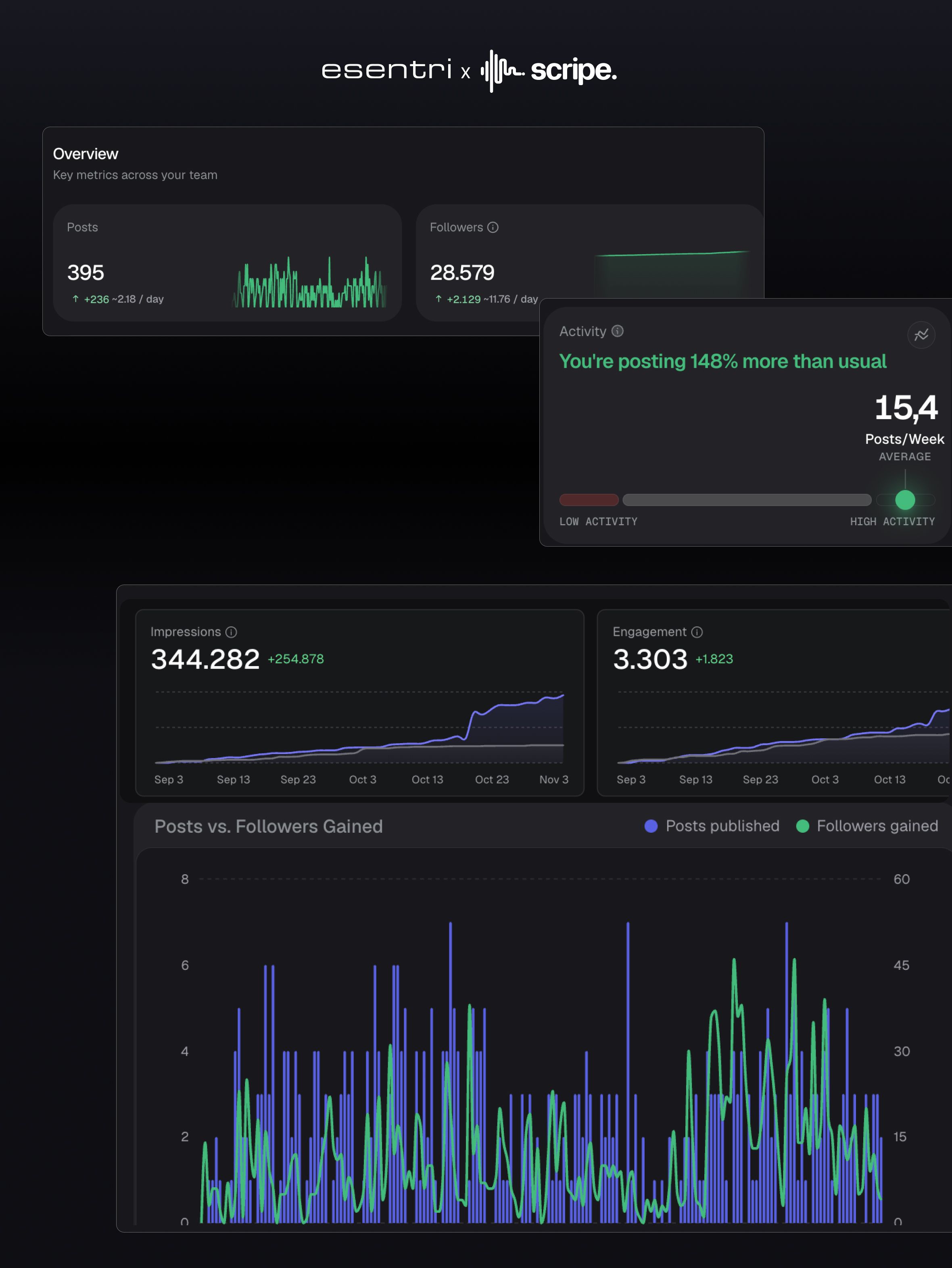
After six months of working together, the numbers speak clearly.
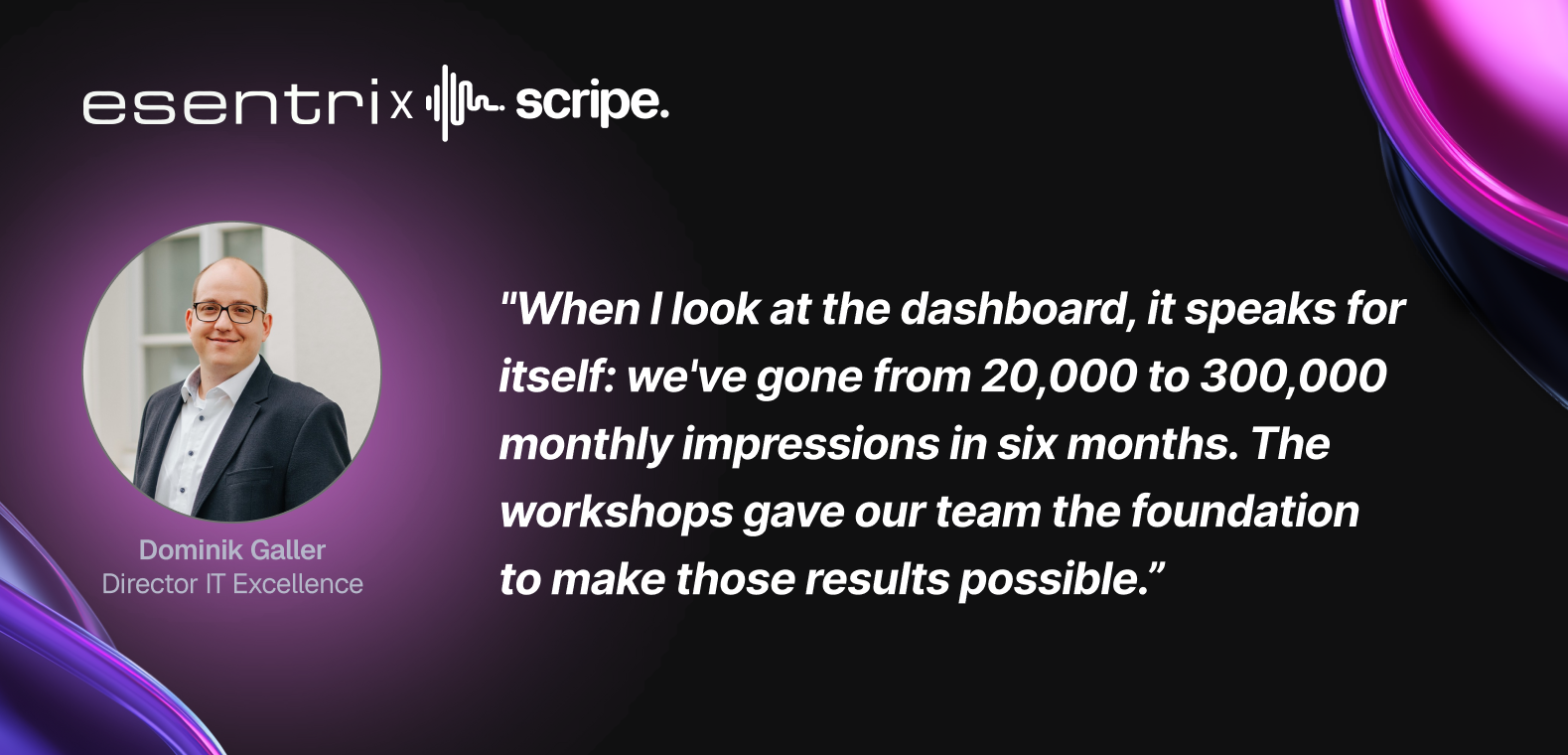
The esentri team's total monthly reach grew from 20,000 to 300,000 impressions – a 15x increase. Follower counts continue to grow week on week. All of this without a ghostwriting agency in the background, without a significant increase in time investment – and without anyone sacrificing family time for LinkedIn posts.
What excites Dominik even more are the qualitative signals:
👉 Conference speaking invitations – while potential prospects telling them that they saw the team’s content on LinkedIn.
👉 A direct approach from a major German cloud provider and potential client after a related LinkedIn post, requesting a conversation.
👉 Clients arriving at first meetings already familiar with the LinkedIn profiles of the consultants they're about to meet.
"Inbound leads don't really work through LinkedIn in our industry – it has to be person to person in the end. But we're expanding our surface area with the world and building new trust-creating structures. And the contacts that come from that are what might eventually generate a lead."
– Dominik Galler
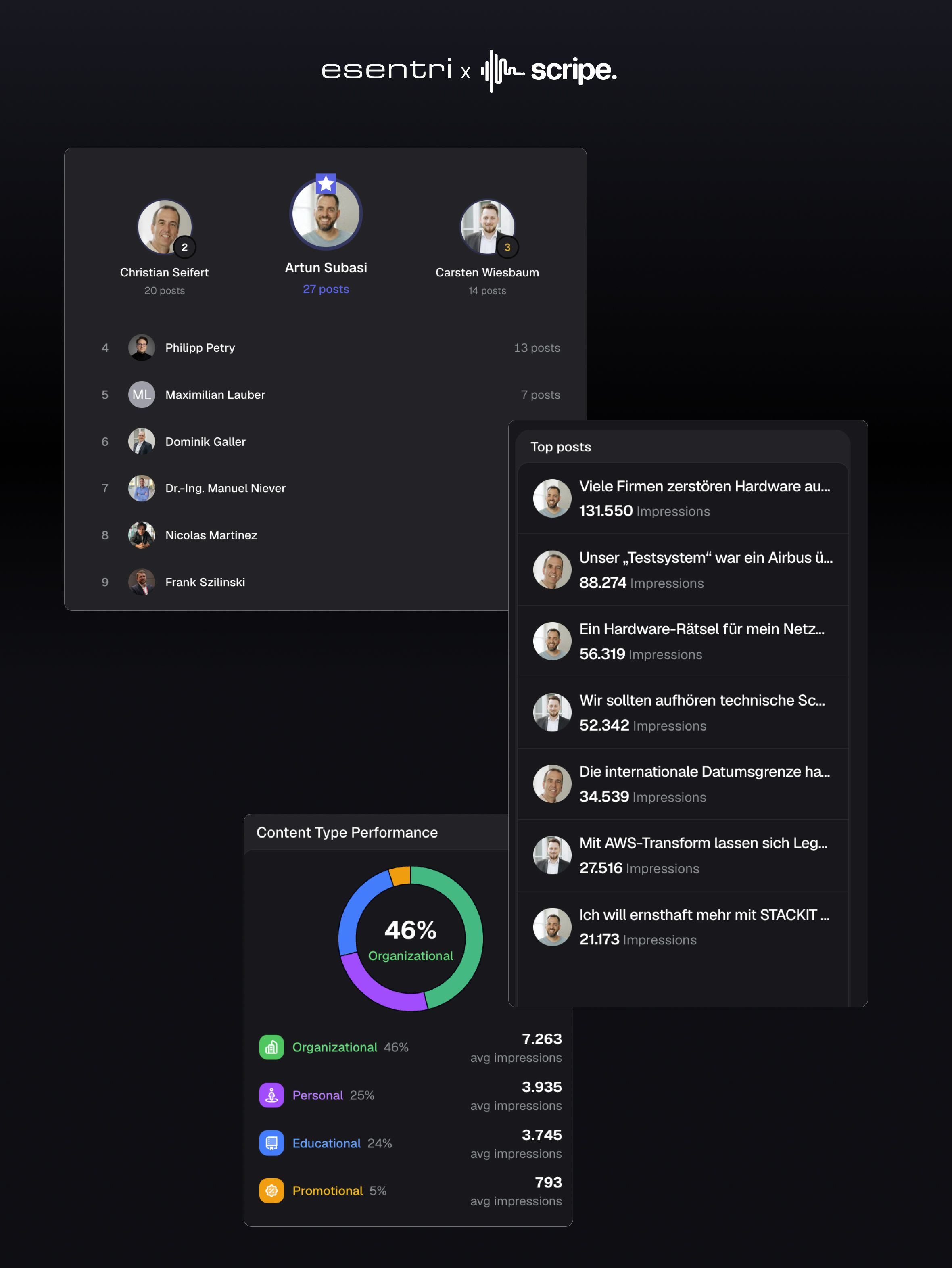
An unexpected side effect also emerged: several team members, through the discipline of regular content creation, had effectively become content machines – using the research they did for LinkedIn posts as the foundation for magazine articles and conference talks.
What's next: Scaling up and one big goal
For the next phase, esentri has a clear priority: consolidate what has been built and bring more colleagues into the system.
"We want to spread Scripe further across the company. We're genuinely convinced it's a great tool – and we want to show more people how it works."
And then there is one more goal that Dominik describes with a smile:
"I'd love to reach a point where clients reach out to us on LinkedIn because they want to be advised by us. That's still a way off – but you're allowed to dream."
– Dominik Galler
Three recommendations from Dominik for companies looking to do the same
When asked what advice he'd give to other organisations standing where esentri stood a year ago, Dominik had clear answers.
1. Commitment and transparency from the start.
Explain to the team why personal brands make sense – for individuals as much as for the company. Without genuine alignment, even the best tool won't move the needle.
2. Keep ownership with the individuals.
Scripe is a tool, not an autopilot. Each person needs to build their content base, curate it, and be willing to invest time. That responsibility should deliberately stay with the employees – not be centralised in marketing.
3. Just start, and figure out what works together.
Don't wait for the perfect process. What works for one person won't necessarily work for the next. The path there runs through experimentation – ideally in ongoing dialogue, supported by workshops and real feedback.
"You have to start. And in starting, you figure out how it works best."
- Dominik Galler, Director IT Excellence, esentri
———
Want to learn more about how Scripe can help your organisation build a scalable LinkedIn presence? Reach out to sales@scripe.io.