

Professional services firms grow through trust – and trust has always been built person by person. At hy Consulting Group, that insight sits at the heart of how they think about marketing.
Amon Menzel, VP Marketing & Communications at hy, had spent the previous decade running content and growth for B2B software companies across Germany, Europe, and North America – largely following the HubSpot playbook of organic search, long-form content, and inbound lead generation.
When he joined hy, he quickly recognized that the rules of the game were shifting: positioning partners as experts and thought leaders had become more important than ever – but execution at scale remained an open question. That's when Amon reached out to Scripe.
What followed was a 90-day sprint that turned a team of 10+ consultants – most of whom had never posted on LinkedIn – into a coordinated personal brand engine. The result: visibility more than tripled, half a million impressions in two months, and the beginning of a genuine mindset shift inside a firm that had historically grown through quiet, relationship-driven consulting. Here's how they did it.
The starting point: A challenger brand in a relationship-driven industry
Amon had spent the previous decade running content and growth largely following the HubSpot playbook. But three things he observed made it clear that the model was changing.
Three moments crystallized his thinking:
- A viral screenshot showing the dramatic traffic decline of HubSpot's own blog — long regarded as the gold standard for B2B content marketing — made it clear that search-driven acquisition was weakening as a channel.
- At the same time, political campaigns in Berlin were increasingly centering individual candidates over party logos — a signal that personal brands were outperforming institutional ones even in the most traditional of contexts.
- And closer to home, Amon noticed more and more people in his network paying more for a single Substack subscription than they ever had for a newspaper.
"We are all overwhelmed by the amount of information we receive every day. We fall back on what we know — and that is trusting people, more than institutions."
- Amon, VP Marketing & Communications, hy Consulting Group
For hy, the implication was clear. Consulting has always grown through personal networks. The question was whether that model could be multiplied — and whether LinkedIn was the right platform to do it.
The answer to both was yes.
The challenge: Scaling personal brands without creating a bottleneck
The strategic direction was clear. But the operational reality was complex.
hy's marketing team is – just three people. The firm wanted to activate not just one or two spokespeople but its entire executive leadership team: a group of 10 to 12 people with different roles, different audiences, different communication styles, and very different relationships with social media.
On top of that, these weren't people with time to spare. Every consultant at hy is also actively working on client projects. Getting them to post consistently on LinkedIn couldn't mean adding a significant burden to their day – or depending on the marketing team to ghostwrite and manage everything individually.
The challenge Amon's team was solving was genuinely hard:
Strong foundation:
✅ Deep expertise across the executive team
✅ Genuine insights and opinions worth sharing
✅ Motivation to build personal visibility
But no scalable execution:
❌ No unified content process
❌ No shared understanding of what "good content" looks like
❌ Different tools, inputs, and habits for every person
❌ Marketing team at risk of becoming the bottleneck
"We needed to find a solution and a process where marketing and my team are not the bottleneck – where we give the executives the right tools and processes to produce content consistently, in a way that fits into a very busy consulting schedule."
– Amon, VP Marketing & Communications, hy
The goal wasn't to create a content factory. It was to enable a mindset shift – moving a group of experienced professionals who weren't natural social media users toward seeing LinkedIn as a natural extension of the work they were already doing.
The approach: Building a scalable content engine with Scripe
hy partnered with Scripe in December 2025 to design and roll out a structured LinkedIn content system across the executive team.
The collaboration had 3 core components:
1. Strategic foundations first
Before any posting began, Scripe ran hands-on workshops to help each participant answer the basic but critical questions: Who is my target audience? What value do I offer them? Which topics do I want to be known for? What is my unique point of view?
These weren't abstract exercises. They translated directly into the logic embedded in the Scripe platform, ensuring that every piece of content created would be grounded in a clear positioning, not just filling a calendar.
"The workshops helped make things much more tangible. You could suddenly see: this is what it looks like when I communicate value for my audience. This is what my content looks like when I've thought about my target group and my point of view."
– Amon
2. Flexible tooling for diverse processes:
One of the biggest risks in rolling out a content program across a diverse team is forcing everyone into the same workflow. Amon's team specifically needed a solution that could adapt to how different people already worked — not impose a new process on top.
Scripe handled this by supporting a wide range of inputs: newsletters, podcast episodes, presentation decks, ideas captured at events, spontaneous observations from client conversations. Whatever an individual executive already had, Scripe could turn into a LinkedIn post.
"Scripe adapted very flexibly to the different needs of each person – different tools, different inputs, different ways of working. Otherwise it would have been a huge uphill battle to try and standardize the entire process from ideation to posting for everyone."
– Amon
3. Gamification to drive adoption:
To build momentum in the early phase, hy created an internal initiative called the High Visibility Challenge – a friendly internal competition running alongside Scripe usage, with extra support on offer for participants. This gave the rollout energy and made the early wins visible to the whole team.
The results: 3x impressions in 90 days – and a real mindset shift
Looking back at the first 90 days of the program, the numbers tell a clear story.
✅ Impressions and visibility increased by more than 300% – compared to the equivalent period before the program launched.
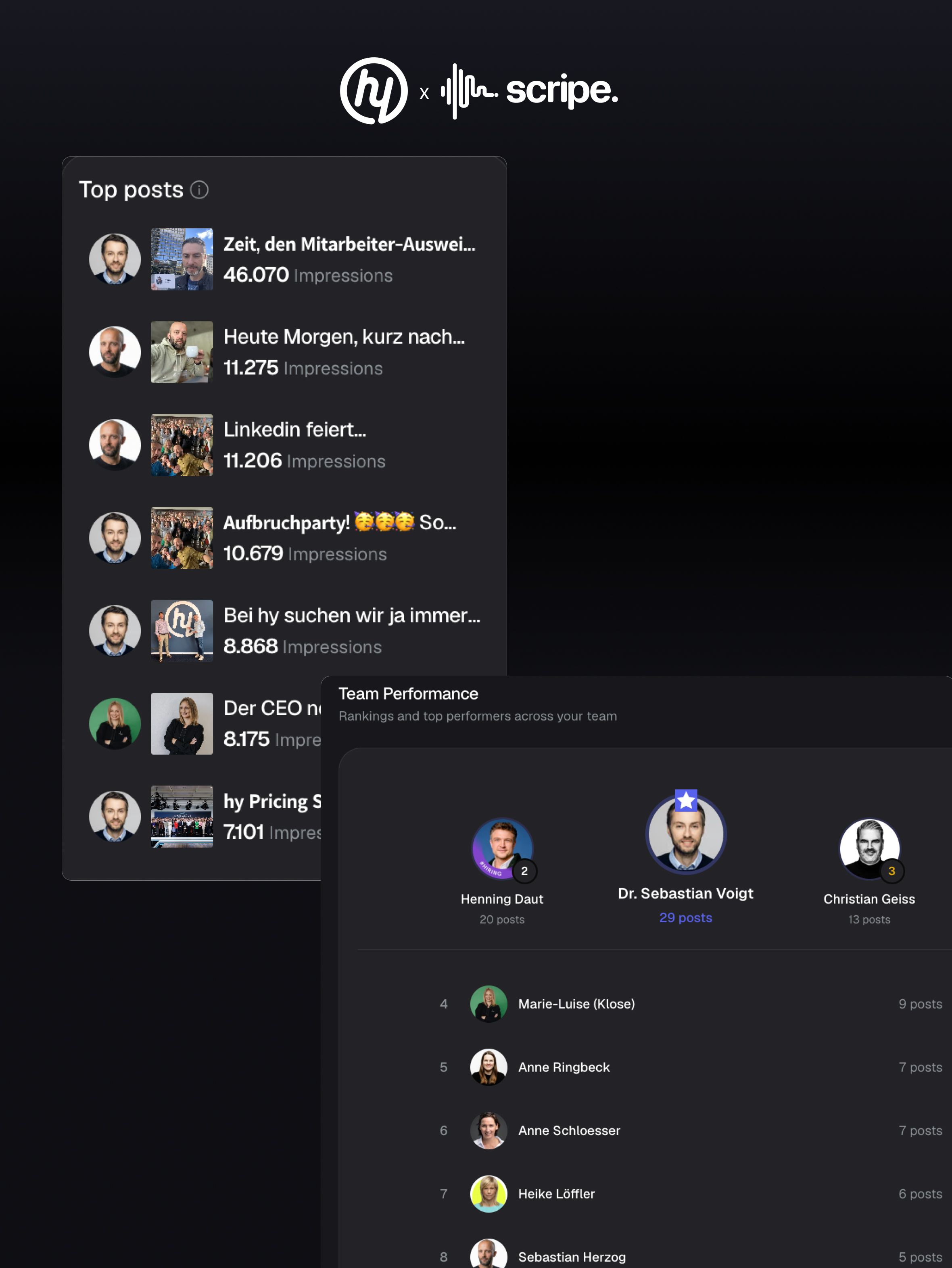
✅ With a group of 10 to 12 executives posting consistently, the team crossed 500,000 impressions within two months.
But for Amon, the more important result is harder to put in a spreadsheet.
"More than 300% visibility increase is a number that makes my marketing heart beat faster. But what makes me personally most happy is that Scripe allowed us to become a many-voices brand at scale – without my team or I becoming the bottleneck."
– Amon
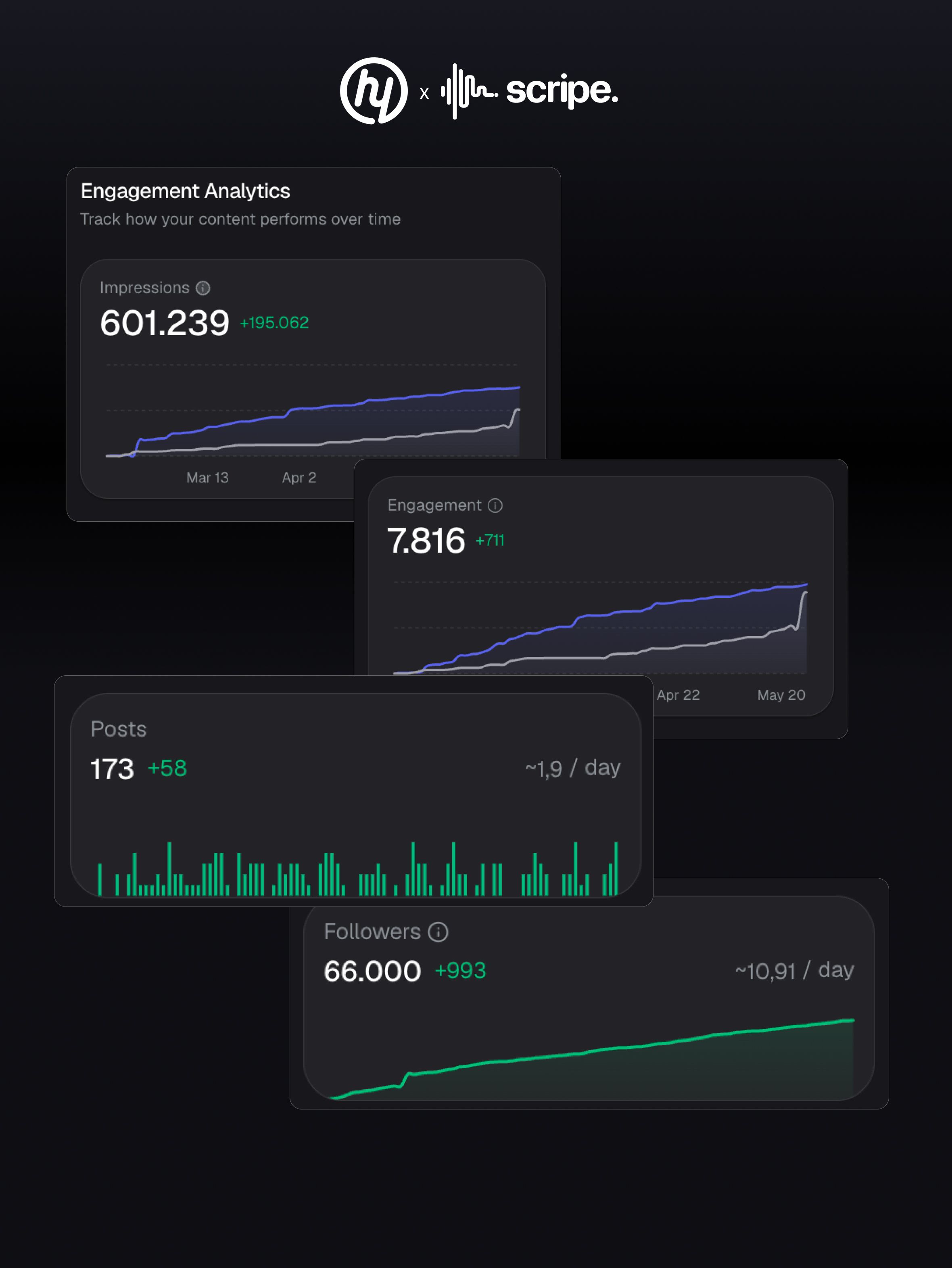
What he is describing is the mindset shift. Consultants who had never posted on LinkedIn — and for whom doing so felt unnatural, even in an industry not known for public self-promotion — began to see it differently. They began to see their daily work as a source of content, not a distraction from it.
That shift, once it takes hold, is what makes the system sustainable.
What's next: From LinkedIn content engine to revenue signal
Phase one was about building visibility. Phase two is about connecting that visibility to business outcomes.
hy's next priorities are split into three focus areas:
1. Deepening the content engine:
The team plans to continue feeding Scripe with the full range of assets they produce — presentations, podcasts, events, newsletters — and building a more systematic content pipeline that flows bidirectionally: from those assets into LinkedIn posts, and from LinkedIn content back into other channels.
2. Better attribution:
Amon's background is in search engine marketing, where attribution was always measurable. LinkedIn operates differently — longer sales cycles, significant dark social, a lot of unattributed influence. hy is building out a "self-attributed reporting" approach using a concept they call Handraisers: tracking which LinkedIn conversations turn into qualified offline discussions and meetings, as a proxy for business impact.
3. Connecting engagement signals to outbound:
The team is also exploring how to use engagement data from LinkedIn — comments, reactions, profile visits — to inform and improve their outbound sales motion.
"We want to get better and more data-driven about linking what we do on LinkedIn with what we see in our project pipeline. That is the next big challenge for us."
– Amon
Three things Amon would tell anyone starting their LinkedIn journey
When asked what advice he would give to a marketing leader standing where he stood a year ago, Amon offered three clear recommendations.
1. Invest in the strategic content engine first:
Before thinking about posting frequency or platform tactics, get the foundations right. Define your audience. Define your value proposition.
Define the topics you want to be known for and what your unique point of view on each one is. This strategic layer is what makes content credible – and what lets you eventually step back from reviewing every post individually.
2. Start with motivated team members:
Don't try to onboard everyone at once. Find the three to five people who are already energized by the idea and build the system around them first. Early wins create momentum, and momentum brings others along far more effectively than any mandate from above.
3. Shift the role of marketing:
The most scalable version of this program isn't one where marketing ghostwrites and approves every post. It is one where marketing provides the right tools, the right frameworks, and the right questions – and then trusts the process.
That requires laying the strategic foundations well. But once you have done that, you can build something lean and truly scalable.
"Give people the right tools and the right processes. Then step back. That is what lets you build something that actually scales."
– Amon, VP Marketing & Communications, hy Consulting Group
-----
Want to learn more about how Scripe can help your team build a scalable LinkedIn presence? Reach out at sales@scripe.io.